
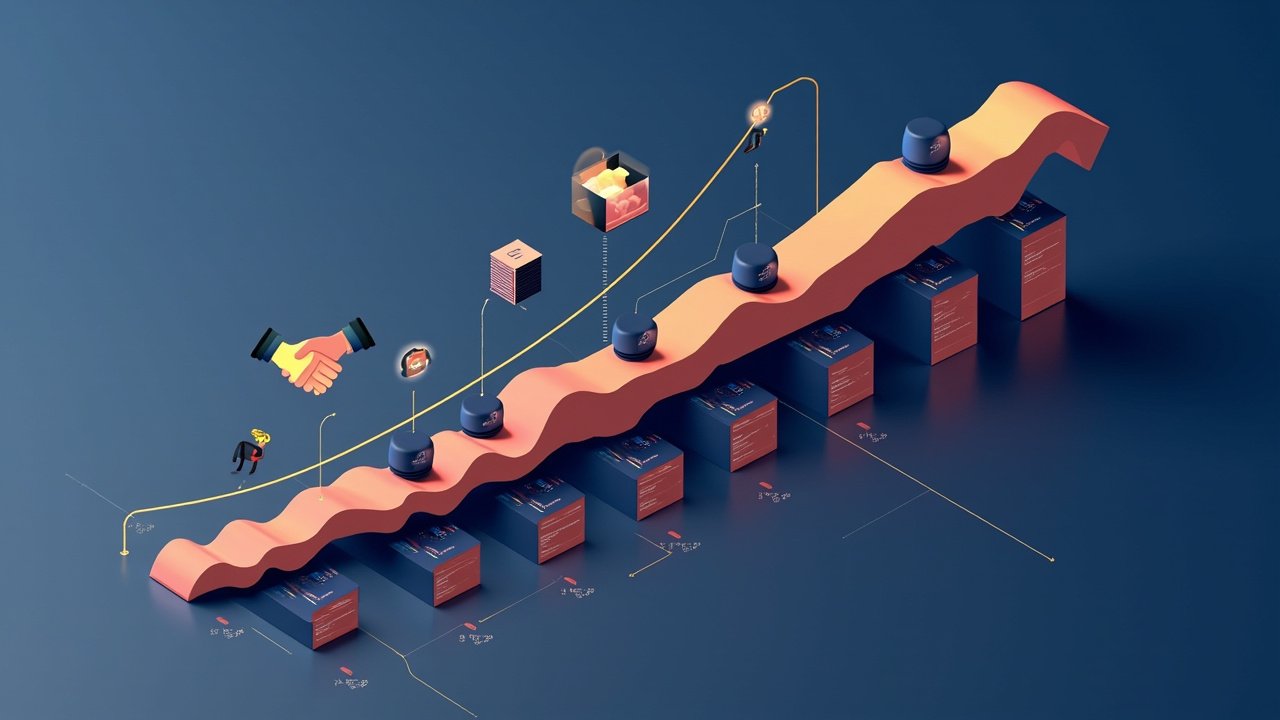
Post-Deal International Expansion: The 12-Month Operating Playbook for Exporters
The First 90 Days playbook ended with a first deal closed. A buyer in a new market signed off, paid the first invoice, and received the first shipment. The exporter raised a glass and updated the next-quarter forecast. That moment is when the 12-month operating playbook actually begins. The ICONIQ 2026 International Expansion Playbook frames it as the make-or-break phase for the entire market commitment. The McKinsey and Customer Success Institute 2026 research on industrial B2B customer success economics puts the same point in numbers: 60% of exporters fumble the post-sale handoff. The second deal in a new market is 5-7x cheaper than the first, but most exporters never get to it. The 12 months after the first deal is the operating phase that decides whether a market is real or a one-off.
The economic structure of the post-deal window
The most important number for any exporter who has closed a first deal in a new market is the cross-sell-to-first-deal cost ratio. The McKinsey and Customer Success Institute 2026 analysis of industrial B2B customer success economics puts that ratio at 5-7x cheaper to win an additional deal at the same account than to win the first deal. The basis is mechanical: the procurement decision is already made, the buyer's relationship with the seller is established, the ordering process is integrated, and the after-sales service infrastructure is in place. The marginal cost of the second sale is dramatically lower than the cost of landing a new account.
The renewal economics tell the same story from a different angle. The McKinsey 2026 data shows that industrial B2B renewal rates are 2-3x higher than new-account acquisition rates. A buyer who has taken delivery on a first order, has not been burned by a wrong shipment, and has good after-sales support will renew the standard 70-80% of the time. A buyer who has not had those three conditions met will renew at 30-50%, and the failure usually does not come back. The Chinese export research tradition has a name for it: the second deal is the proof of the first deal. The Western McKinsey frame is that the second deal is the cheapest expansion you will ever make. The two traditions agree on the structural conclusion: the 12-month window after the first deal closed is the operating phase that determines whether the market is profitable or a one-off.
The Forrester 2026 State of B2B Channel and Partner Sales report adds the third leg of the stool: after-sales service infrastructure — spare parts inventory, local repair capability, response time commitment — is the #1 predictor of year-2 renewal rates. The Forrester 2026 data shows that exporters who invest in after-sales service infrastructure before the second deal closes see year-2 renewal rates that are 14-18 percentage points higher than exporters who defer the investment. The reason is that renewal is not a function of the renewed order; it is a function of the buyer's experience with the first order. If the first order's spare parts arrive in three weeks and the original equipment runs at 90% uptime, the renewal decision is automatic. If the first order's spare parts arrive in twelve weeks and the equipment runs at 60% uptime, the renewal decision is already contested.
The 12-month operating playbook: month by month
The 12-month operating playbook is structured around four decisions, each paced into a specific quarter. The McKinsey and Customer Success Institute 2026 data, combined with the ICONIQ 2026 framework and the Forrester 2026 channel research, divide the year into four 90-day operational phases. Each phase has a primary decision, a primary risk, and a primary resource investment. The exporter who knows the four phases in advance does not have to make the decision under pressure.
Phase 1: Months 1-3 — Make the first deal repeatable
The first 90 days after the first deal is the cash-conversion phase. The primary decision is whether the first deal can be repeated without heroic effort. The primary risk is fulfilment friction — late shipments, customs delays, currency mismatches, payment terms that don't match the buyer's cash flow. The McKinsey 2026 data shows that 30% of post-deal churn in industrial exports is attributed to logistics and payment friction, not product quality. The exporter that ignores this data is the exporter that loses the second deal.
The operational actions are mundane but decisive. Run the first deal's fulfilment from production through delivery with explicit timestamps at each step. Identify the friction point — usually customs clearance or shipping documentation. Hire a local freight forwarder in the buyer's country if you do not have one. The Forrester 2026 channel data shows that the exporters who solve fulfilment friction in the first 90 days have 70% second-order rates. The exporters who solve it later have 35% second-order rates. The first 90 days determines whether the operational back office can carry the market. The McKinsey 2026 customer success data shows that the buyer's second-order decision is made in the first 90 days, not later. The buyer's renewal decision is not a Q4 conversation; it is a Q1 experience.
Run a formal post-sale review at the end of the first 90 days. The review should include the buyer, the buyer's procurement team, the exporter's operations team, and the local distributor if one exists. The ICONIQ 2026 framework recommends a structured QBR-style review at the end of months 1, 3, 6, 9, and 12. The first one is the most important because it sets the cadence. The Forrester 2026 channel data shows that exporters who run quarterly distributor business reviews with their distribution partners achieve 28% higher partner-sourced revenue in years 2-3. The same cadence applies to direct customer relationships in the first 12 months.
Phase 2: Months 4-6 — Build the renewal pipeline
The fourth, fifth, and sixth month is the formal renewal pipeline building phase. The primary decision is whether to invest in local presence (sales engineer, customer success, or distributor representative) or continue remote management. The primary risk is the buyer feeling under-served relative to the alternatives they are now evaluating. The McKinsey 2026 customer success data shows that 68% of B2B buyers evaluate at least three alternative suppliers within 12 months of closing their first deal. The renewal pipeline is the response.
The decision on local presence is the most consequential one of the 12-month window. The McKinsey 2026 customer success data and the Forrester 2026 channel data converge on a clear rule: remote management works for the first 3 deals, breaks at 5 deals. The break point is local product complexity, local compliance, or local natural-language coverage. The break point is not revenue size. Three deals at $50K each ($150K total) can be remote. Five deals at $30K each ($150K total) usually cannot. The transaction shape matters more than the cumulative revenue. The Forrester 2026 channel research puts the threshold at 5 deals, the McKinsey 2026 puts the threshold at 3 to 5 deals, and the ICONIQ 2026 framework recommends local presence once the operator has clear evidence of $1M+ forward revenue in the market.
The exporters who get the local presence decision right typically make it during month 4-6 because the data is fresh and the first deal's economics are visible. The exporters who get it wrong typically make it during month 9-12 after they have already lost a renewal or two. The right way to frame the decision is to look at the renewal pipeline — the second deal, the third deal, the renewal of the first — and ask whether remote management can win all of them. If the answer is yes, defer local presence. If the answer is no, hire. The McKinsey 2026 data on the failure to do this is sharp: 60% of exporters who fumble the post-sale handoff lose the market entirely within 18 months. The handoff failure is the operational moment that loses the market. The second deal is the proof. The 12-month operating playbook is the structure that makes the second deal happen.
Phase 3: Months 7-9 — Expand the relationship depth
The seventh through ninth months is the relationship-depth expansion phase. The primary decision is whether to invest in joint marketing with the buyer or the local distributor, and whether to expand the SKU/line coverage. The primary risk is staying flat — meeting the renewal demand but not expanding the share of the buyer's wallet. The McKinsey 2026 data shows that buyers who experience flat product coverage after the first deal gradually substitute competitors for the categories the exporter does not cover. The substitution slow, but the cumulative effect by month 12 is 15-20% of the annual revenue gone.
The Forrester 2026 channel research documents that joint marketing with distributors doubles pipeline contribution. The same dynamic applies to direct customer relationships — joint case studies, joint webinars, joint reference programs. The exporter who is willing to co-invest with the buyer in marketing the first deal's successes is the exporter who gets the second deal's expansion. The McKinsey 2026 customer success data shows that customers who report high co-marketing engagement in the first 12 months are 2.3x more likely to expand their product line with the same supplier in the next 12 months. The relationship is the expansion. The exporter who treats the first deal as a delivery problem and the second deal as a delivery problem will lose to the exporter who treats the first deal as the start of a partnership.
The SKU/line expansion decision is the second-order decision. The ICONIQ 2026 framework recommends that exporters add SKUs only when the first deal's category is at 60%+ renewal rate and the buyer's category growth is 5%+ year-over-year. The combined filter ensures that SKU expansion is into a healthy relationship, not a relationship that is already weakening. The McKinsey 2026 data shows that SKU expansion in a healthy relationship increases the renewal rate by 7-10 percentage points. SKU expansion in a struggling relationship decreases the renewal rate by 12-15 percentage points. The sequencing matters. The 12-month operating playbook is the structure that makes the sequencing explicit.
Phase 4: Months 10-12 — Decide on the second market
The tenth through twelfth month is the second-market decision phase. The primary decision is whether the operational evidence in the first market is strong enough to invest in a second market. The primary risk is premature expansion — opening a second market before the first market is on a $1M+ annual revenue trajectory with 60%+ renewal rates. The ICONIQ 2026 framework is explicit: do not expand to a second market before the first market is on a self-sustaining trajectory. The McKinsey 2026 customer success data shows that 70% of second-market expansions that fail are due to first-market operational weakness that should have been the gating signal.
The evidence in the first market that gates a second market is concrete. The buyer-side evidence is a 60%+ renewal rate on the first deal, at least one account that has expanded the SKU/line, and a buyer reference who will speak to a prospective second-market buyer. The operational evidence is a local presence strategy that is either working (one full-time local rep or a high-functioning distributor) or a clear plan to hire. The Forrester 2026 channel data shows that the second-market expansion is 2.3x more likely to succeed when the first-market operational evidence is captured and documented before the second-market launch. The discipline is to write the first-market annual report before opening the second-market budget. The ICONIQ 2026 framework recommends a 5-step readiness gate: first-market revenue self-sustaining, first-market renewal rate 60%+, first-market local presence established, second-market opportunity sized, and second-market investment $1M+ approved. The 12-month operating playbook is the structure that produces the first four inputs to the gate. The gate is the decision point.
The 12-month operating playbook as the second deal's preconditions
The 12-month operating playbook is not a sequence of best practices. It is a sequence of preconditions for the second deal. The McKinsey 2026 customer success data shows that the second deal is 5-7x cheaper than the first. The Forrester 2026 channel data shows that joint marketing doubles pipeline contribution. The ICONIQ 2026 framework operationalizes both findings as a sequence of preconditions that, when met, make the second deal a natural continuation rather than a separate sale. The operational structure is the difference between a market that compounds and a market that resets after the first deal. The exporter who understands the structure compounds. The exporter who understands only the first deal resets.
The 12-month operating playbook is the difference between an industrial export market that is profitable in year 3 and one that is a permanent cost center. The McKinsey 2026 data and the Forrester 2026 data agree on the core number: 60% of exporters who fumble the post-sale handoff lose the market within 18 months. The 30% who do not fumble it have a 60%+ probability of year-3 profitability. The 12-month operating playbook is the operational structure that puts the exporter in the 30% that compounds. The cost of the structure is the cost of a QBR cadence, a local presence decision, a SKU expansion decision, and a second-market readiness gate. The cost of not running the structure is the loss of the second deal, the third deal, the year-2 renewal, and the year-3 market.
Salebrate works with mid-market industrial exporters and manufacturers to design and run the 12-month operating playbook. The work typically includes the post-sale review process, the local presence decision, the joint marketing cadence, and the second-market readiness gate. A 30-minute working session is the fastest way to map where your team's post-deal motion is at risk and what the 12-month operating structure looks like for your specific market.