
B2B Sales Handoff Governance in 2026 — BDR-to-AE, AE-to-SE, and AE-to-CSM Handoffs with Acceptance Criteria and 30-Day Adoption Metrics
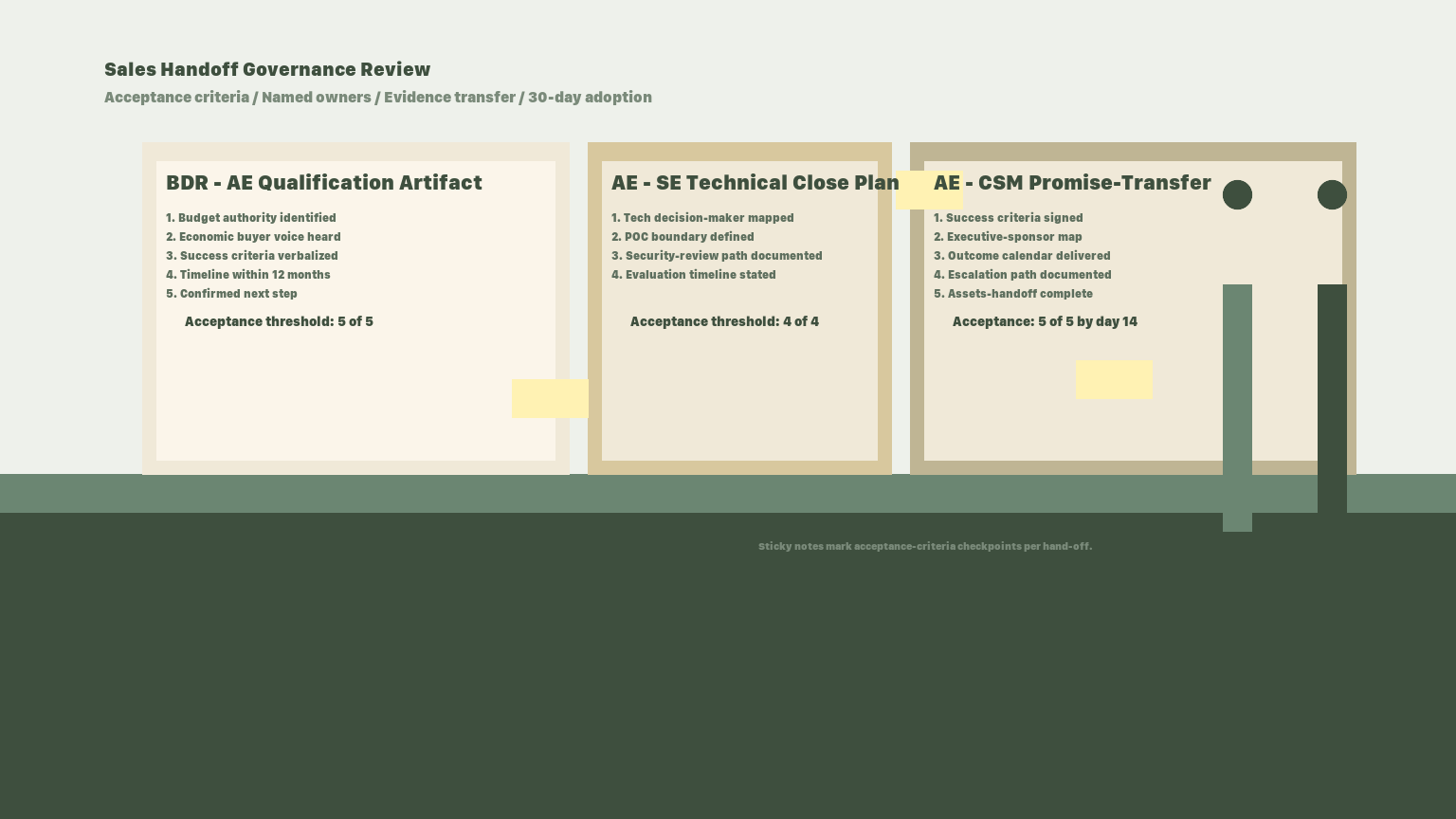
B2B sales handoff governance is the documented control system that defines acceptance criteria at every cross-team hand-off in the revenue cycle, names an owner for each hand-off per side, publishes the evidence that must transfer, sets re-engagement rules when a hand-off fails, and instruments 30-day adoption metrics so the hand-off quality becomes auditable rather than private. In 2026, most B2B organizations understand that information dies at team boundaries; the problem is that the hand-offs operate as verbal handshakes without acceptance criteria, without evidence transfers, without named owners per side, and without a 30-day adoption metric to make the failure visible. This article lays out the governance model for the three highest-leverage hand-offs in a B2B revenue cycle — the BDR-to-AE qualified-meeting hand-off, the AE-to-SE technical-close-plan hand-off, and the AE-to-CSM promise-transfer hand-off — each with documented acceptance criteria, a named hand-off owner per side,
The case for hand-off governance is not theoretical
The case for hand-off governance is not theoretical. Gartner's B2B sales enablement research finds that BDR-to-AE qualified-meeting hand-offs without documented acceptance criteria produce materially higher downstream qualification-loss rates than hand-offs with a named hand-off owner and a documented acceptance checklist, and the qualification-loss gap compounds through the rest of the cycle. Gong Labs deal execution research finds that AE-to-SE technical hand-offs initiated after the discovery stage are associated with shorter late-stage cycles and higher technical-win rates than hand-offs initiated later, and that the documented technical-close plan is a leading indicator of technical qualification. Forrester's 2024 Customer Success research finds that AE-to-CSM hand-offs that include a documented promise-transfer artifact produce materially faster time-to-value and higher 12-month renewal probability than hand-offs without the promise-transfer, and that the hand-off owner named per side reduces post-handoff drift. TSIA's 2024 Sales Operations research identifies the named hand-off owner as the structural answer to the most common pipeline leak in mid-market B2B sales organizations — information dying at the team boundary — and recommends 30-day adoption metrics as the diagnostic instrument that makes hand-off quality auditable.
The failure pattern is recognizable from any pipeline review
The failure pattern is recognizable from any pipeline review. A BDR books a meeting the AE would never have accepted, the AE's first call discovers a steering committee nobody mapped, the deal enters qualification with a budget signal that the AE reads as confirmed but the discovery call later reveals was qualified only as a directional number. Two seams later, an AE and an SE are running a technical deep-dive on a deal where the technical hand-off happened at minute one of the discovery call rather than after the technical-buying-committee map was complete; the SE spends the first forty minutes on questions the AE should have surfaced. Two seams further along, an AE closes a deal on a March 28 call and a CSM inherits the customer on April 12 with a vague success plan, a verbal executive-sponsor map, and a list of promised outcomes that never made it into a written artifact. Twelve months later, the renewal is at risk because the customer's executive sponsor never met the CSM in writing and the promised outcome trail lives only in the AE's inbox.
## What sales handoff governance actually governs
## What sales handoff governance actually governs
It helps to be precise, because the word hand-off
It helps to be precise, because the word hand-off gets used loosely. The governed asset is the cross-team hand-off: the deliberate transfer of a deal, a customer, or a workstream from one named team owner to another, including the artifact transferred, the named owner per side of the hand-off, the acceptance criterion at the receiving end, and the re-engagement rule on hand-off failure. Governance, then, is the set of standing rules around those hand-offs. It defines the three named hand-offs in the B2B revenue cycle — BDR to AE, AE to SE, AE to CSM — the acceptance criteria at each, the evidence artifacts transferred, the named hand-off owners per side, the re-engagement rules on hand-off failure, and the 30-day adoption metrics that make hand-off quality auditable. None of these rules are exotic in isolation. What is novel in most organizations is publishing them in one place, naming the owners, and insisting on the adoption metric.
## The BDR-to-AE qualified-meeting hand-off
## The BDR-to-AE qualified-meeting hand-off
The first hand-off is the entry point of the
The first hand-off is the entry point of the active sales cycle: the BDR to the account executive. The hand-off fails in two predictable ways. Either the BDR books a meeting the AE accepts without genuine qualification, in which case the AE's first call spends an hour finding out the deal is not real, or the BDR books a meeting and the AE accepts with verbal qualification that later proves inaccurate, in which case the discovery process restarts to repair a gap that should not have existed in the first place. Both failure modes compound: the AE's downstream pipeline is contaminated, the BDR's reputation is damaged, and the buyer's confidence drops when a second seller repeats the discovery work the first seller already attempted.
The acceptance criteria for a BDR-to-AE hand-off are five
The acceptance criteria for a BDR-to-AE hand-off are five and they are checkable in writing. A qualified meeting arrives at the AE only when the BDR has, in writing, a documented budget authority identified (a named human with discretionary budget for the deal size the AE is being asked to carry), a named economic buyer whose voice has been heard (typically through a quoted statement in the meeting transcript or a pre-call note from the BDR), documented success criteria the buyer has verbalized (not just inferred from the BDR's read of the buyer's title), a stated timeline that matches the seller's sales cycle (typically a closure window within twelve months for mid-market, eighteen for enterprise), and a confirmed next step the buyer has agreed to (typically a discovery call on the calendar with a stated objective). The artifact that carries these five items is the qualification artifact — a one-page document the BDR writes and the BDR's manager reviews before the meeting reaches the AE.
A 60-Day Stand-Up Plan
## Closing handshake with adjacent governance
Sales hand-off governance does not live alone. The same named-owner thinking governs the AE-to-CSM-adjacent [customer onboarding handoff](/blog/b2b-customer-onboarding-handoff-governance-2026/) — sales hand-off governance is the upstream acceptance ritual, onboarding handoff governance is the downstream acceptance ritual. The same acceptance-criteria thinking governs the [RFP response intake gate](/blog/b2b-rfp-response-governance-2026/) — every acceptance criterion is a documented rule that survives the team's turnover. The same 30-day adoption-metric thinking governs the [customer business review cadence](/blog/b2b-customer-qbr-ebr-governance-2026/) — every customer-facing ritual earns its keep through a documented adoption score. Hand-off governance is the connective tissue between these adjacent disciplines, and the named-owner discipline compounds across the entire revenue cycle rather than only at the seams.