
B2B Customer QBR and EBR Governance in 2026 — Executive-Sponsor Cadence, Value-Realization Dashboard, and the Expansion Bridge That Earns Renewal
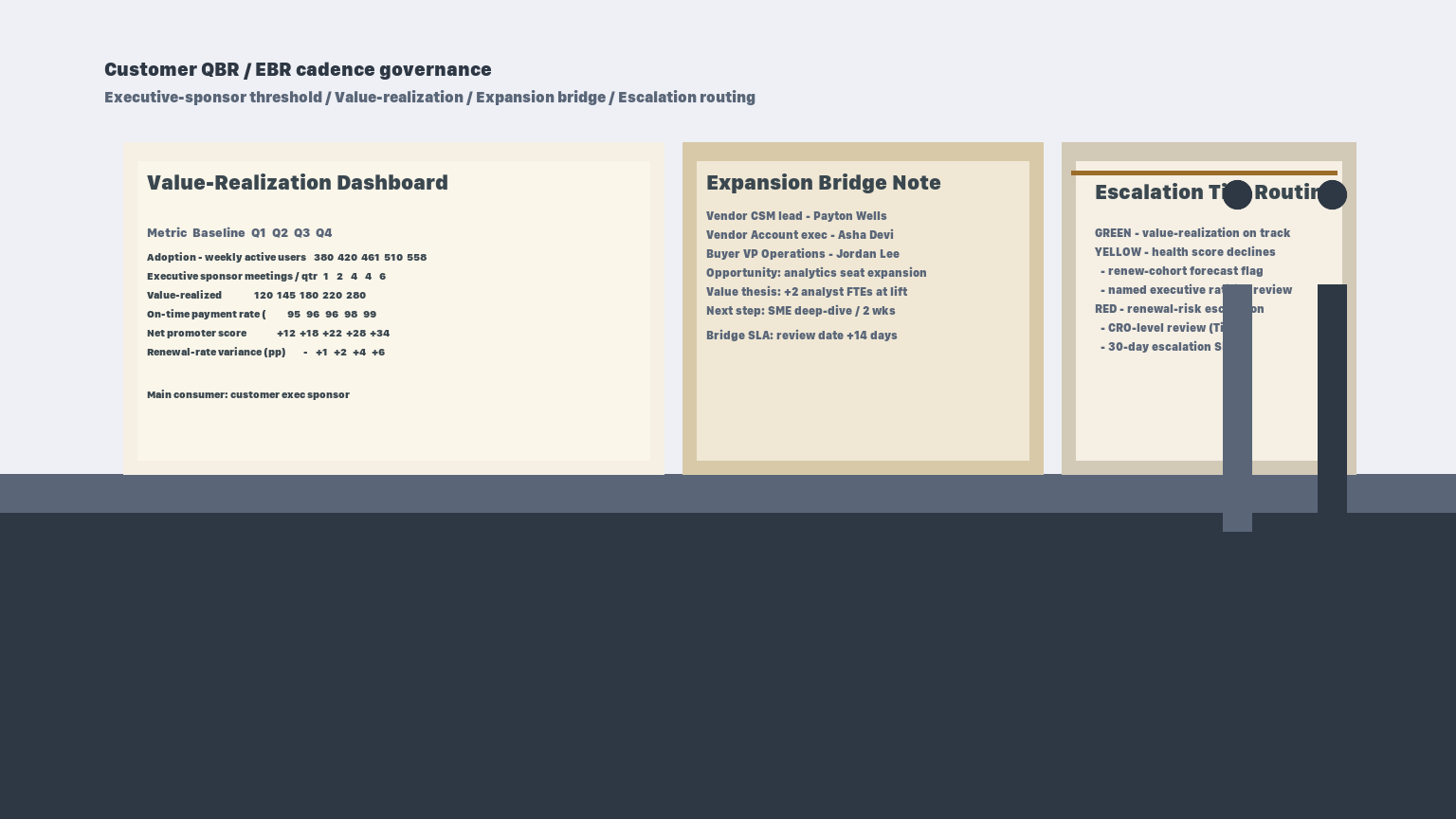
B2B customer QBR (quarterly business review) and EBR (executive business review) cadence governance is the documented control system that defines when a vendor runs a business review with a customer, who attends from each side at what account tier, what the value-realization dashboard measures, how the review output hands off into the renewal or expansion pipeline, and how the escalation-tier integration routes the review outcome into the renewal-cohort forecast. In 2026, most B2B organizations understand the importance of customer business reviews; the problem is that the reviews run on demand rather than on a documented cadence, with vague attendance from the customer's executive sponsor, with a deck that summarizes activity rather than measures value realization, and with no documented expansion bridge that hands the review output into the renewal or expansion pipeline. This article lays out the governance model for a vendor-led business-review cadence: executive-sponsor attendance
The case for business-review governance is not theoretical
The case for business-review governance is not theoretical. Gartner's 2024 Customer Success Management research finds that vendors running a documented customer QBR/EBR cadence with executive-sponsor attendance thresholds report higher net revenue retention and stronger year-over-year executive-sponsor engagement than vendors whose business reviews are run on demand, and that the named executive ratifier per review is the structural element that makes the cadence auditable. Forrester's 2024 Customer Success research finds that vendors running a value-realization dashboard with a documented mapping to renewal-rate outcomes report higher gross retention and larger expansion pipeline than vendors whose QBRs summarize activity without measuring value-anchor outcomes, and that the dashboard's main consumer should be the customer's executive sponsor. TSIA's 2024 Customer Success Operations research finds that vendors that document an expansion bridge between the QBR outcome and the renewal or expansion pipeline lift expansion-pipeline contribution from business reviews and shorten expansion cycle time versus vendors whose QBR outputs end at the meeting close, and that the bridge needs a documented named owner per side. Gainsight's 2024 Customer Health Benchmarks find that vendors with a documented escalation-tier integration produce higher retention-driver forecast accuracy and earlier at-risk renewal detection, and that the integration is the structural link between the QBR cadenc
The failure pattern is recognizable from any renewal review
The failure pattern is recognizable from any renewal review. A customer's CSM sent a QBR deck three weeks before renewal; the customer's executive sponsor skimmed the first three slides, attended the meeting for thirty minutes of a sixty-minute slot, and left with a one-line summary in the sponsor's inbox that mentioned activity volume but did not mention value realization, expansion readiness, or renewal outcome. Two months later, the renewal lands in the renewal-cohort forecast and the renewal review discovers that the value-realization story the seller had been telling was never shared in writing with the customer's executive sponsor; the customer's evaluation of the renewal starts from scratch because the documented narrative was missing. A similar pattern emerges at the expansion conversation: a CSM identifies an expansion opportunity during the QBR but does not have a documented expansion bridge to route the opportunity into the account executive's pipeline, the opportunity stays in a CSM-side note, and at renewal time the expansion conversation has to start from zero. The QBR cadence produced activity; it did not produce renewal readiness. The two gaps are connected, and they share a structural answer.
## What customer business-review governance actually governs
## What customer business-review governance actually governs
It helps to be precise, because the words QBR
It helps to be precise, because the words QBR and EBR get used loosely. The governed asset is the vendor-led business review: a documented meeting between vendor and customer at a published cadence, with documented attendance thresholds, a documented agenda anchored on a value-realization dashboard, a documented expansion bridge, and a documented escalation-tier integration. The cadence owns the interval — quarterly, semi-annual, or annual depending on the account tier. The attendance-threshold rule owns the named executives required per tier. The dashboard owns the value-realization metrics. The bridge owns the handoff from the review outcome into the renewal or expansion pipeline. The escalation-tier integration owns the routing of the review outcome into the renewal-cohort forecast. None of these rules are exotic in isolation. What is novel in most organizations is publishing them in one place, naming the owners per tier, and instrumenting the expansion bridge and escalation-tier integration as standing routines rather than improvised follow-ups.
## Executive-sponsor attendance thresholds and tiered cadence
## Executive-sponsor attendance thresholds and tiered cadence
The first control is the cadence and the attendance-threshold
The first control is the cadence and the attendance-threshold rule. The cadence publishes, per account tier, the interval at which the vendor runs a business review with the customer's executive sponsor. A workable tiered cadence publishes quarterly business reviews for the top-decile strategic accounts, semi-annual business reviews for the next three deciles, and an annual business review for accounts below the strategic threshold, with documented criteria for upgrading or downgrading an account tier between cycles. The attendance-threshold rule publishes, per tier, the minimum attendance required on each side: for the top decile, the CRO or the customer's C-suite on the customer side and the CRO on the vendor side; for the next three deciles, an RVP on each side or their named delegate; for the annual tier, a director or the named strategic-account owner. Meetings below the threshold are rescheduled rather than held, because the structural value of the review depends on the executive sponsor's presence.
The cadence and the threshold share a named executive
The cadence and the threshold share a named executive ratifier per review. The ratifier's job is to ratify the value-realization dashboard consumed at the review, the expansion bridge hand-off resulting from the review, and the escalation-tier routing triggered by the review. The ratifier is the owner of the tiered cadence's integrity and is the published accountability for the cycle's compliance with the cadence policy. Without a ratifier, the cadence becomes a calendar and the threshold becomes a polite request; with a ratifier, the cadence becomes a structural instrument and the threshold becomes a contract.
A 60-Day Stand-Up Plan
## Closing handshake with adjacent governance
Customer business-review governance does not live alone. The same value-realization thinking governs the customer-side [health-score governance model](/blog/b2b-customer-health-score-governance-2026/); the same expansion-bridge thinking governs the [account-planning cadence](/blog/b2b-account-planning-cadence-governance-2026/) at the KAM level; the same escalation-tier thinking governs the renewal-cohort forecast layer underneath the [B2B renewal forecasting governance](/blog/b2b-renewal-forecasting-governance-2026/). Customer business-review governance is the connective tissue between the customer's strategic-account relationship and the vendor's renewal-cohort forecast, and the named-owner discipline compounds across the entire customer-success cycle rather than only at the business review.