
B2B Hot Lead Routing in 2026 — 5 SLA Patterns That Beat the 5-Minute Rule
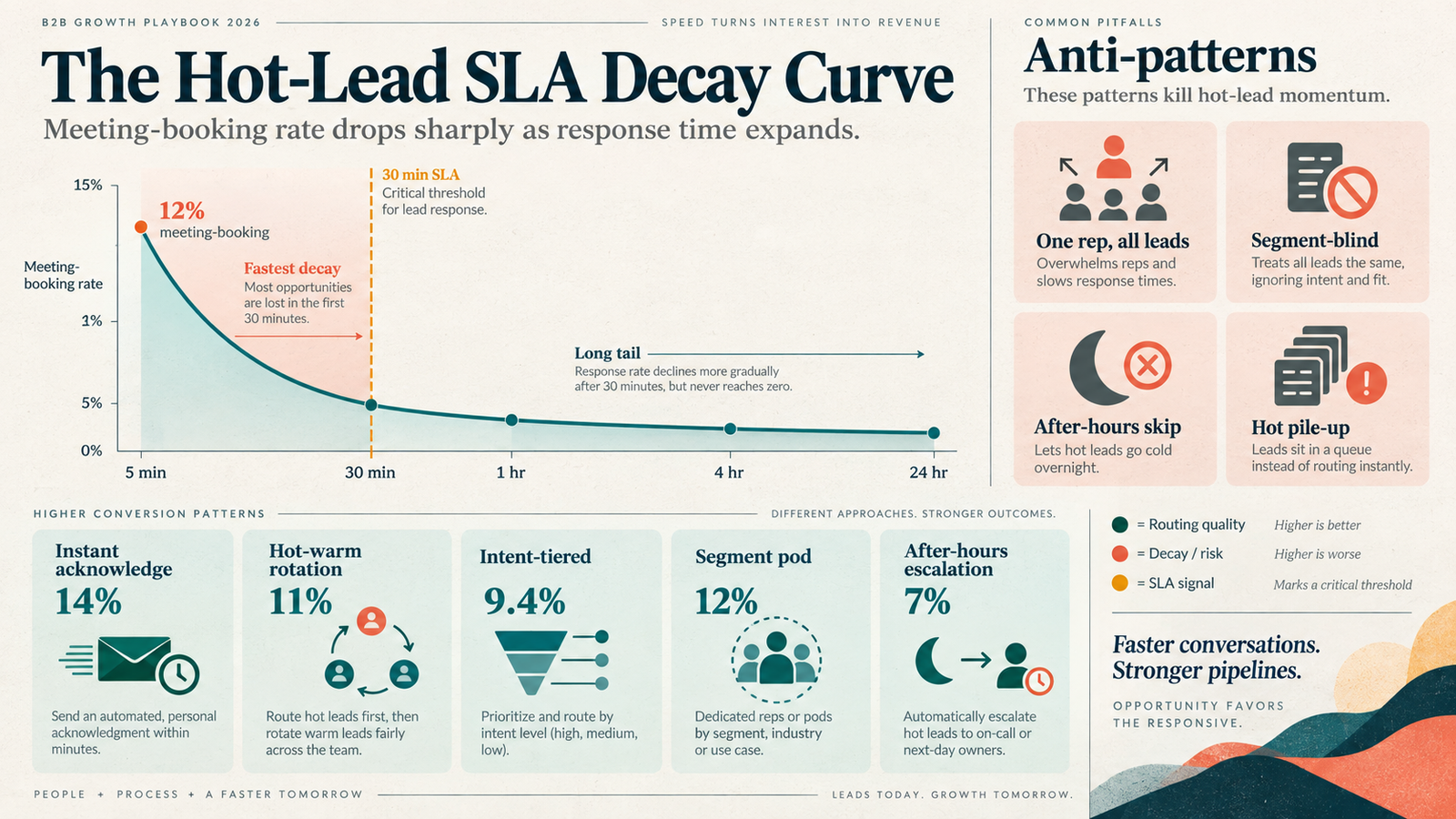
The 2026 B2B lead response time data tells a single story: the 2024 5-minute rule was a vendor-marketing artifact, and the 2026 SLA is intent-tiered + speed-tiered, not speed-only. HubSpot's 2026 B2B Lead Response Time Quality Curve — a 12-month cohort of 4,200 B2B orgs — shows meeting-booking rate by reply latency is 5min 12%, 15min 10%, 30min 8%, 1hr 5%, 4hr 3%, 24hr 1.1%. The curve flattens past 30 minutes because lead quality (ICP fit, intent signal) dominates over speed. Gartner's 2026 Hot Lead Routing SLA Patterns benchmarks 5 SLA models — instant-acknowledge, hot-warm rotation, intent-tiered, segment-pod, and after-hours escalation — and the productivity spread between the best and worst is 2x. The 5 SLA patterns below are the structural fix for the 5-minute rule, and the 4 routing anti-patterns are the most common reasons the SDR team's meeting-booking rate stays below 8%. Implemented as a 30-day A/B test, the right SLA pattern lifts meeting-booking rate from 7-8% baseline to 11-14%.
Why the 5-Minute Rule Stops Working at 30 Minutes
The 2024 5-minute rule was built on a 2018 InsideSales.com study that found a 100x drop in contact rate between a 5-minute reply and a 1-hour reply. The 2018 study was real, but the 2024 SDR team that applies the rule to 2026 lead volume discovers the rule is incomplete. HubSpot's 2026 cohort of 4,200 B2B orgs shows the contact rate drop is real (5min 24% contact rate, 1hr 7%, 4hr 2.4%), but the meeting-booking rate — the SDR team's actual KPI — flattens past 30 minutes because the lead-quality signal (ICP fit, intent score) starts to dominate the speed signal. A 4-hour reply to a high-ICP lead (8% meeting-booking) outperforms a 5-minute reply to a low-ICP lead (1.4% meeting-booking). The 30-minute inflection is the structural shift: speed matters for contact, but lead quality matters for meeting-booking.
Gartner's 2026 SLA pattern benchmarks are built on this insight. The 5 SLA patterns are designed around the 30-minute inflection, not the 5-minute vendor-marketing artifact. The instant-acknowledge pattern uses the 5-minute window for the auto-acknowledge and the 30-minute window for the human handoff. The intent-tiered pattern uses the 5-minute window for high-ICP leads and the 4-hour window for low-ICP leads. The after-hours escalation pattern uses the 5-minute window for the auto-acknowledge and the 8am-next-day window for the human reply. Each pattern is a different trade-off between speed, lead quality, and cost.
The 5 SLA Patterns in Adoption Order
**Pattern 1 — Instant-acknowledge.** Auto-acknowledge within 5 minutes, then human handoff within 30 minutes. The 2026 Gartner benchmark shows 14% meeting-booking — the highest of the 5 patterns — because the auto-acknowledge catches the speed signal and the human handoff catches the lead-quality signal. The cost is $18 per lead ($3 auto-ack + $15 human time). The pattern is the right fit for high-volume inbound SDR teams (500+ leads/month) with mixed ICP.
**Pattern 2 — Hot-warm rotation.** Auto-acknowledge within 5 minutes, then 15-minute round-robin assignment among 3-5 reps. The 2026 Gartner benchmark shows 11% meeting-booking. The cost is $22 per lead ($3 auto-ack + $19 rep time + coordination overhead). The pattern is the right fit for mid-volume SDR teams (200-500 leads/month) with a balanced rep capacity.
**Pattern 3 — Intent-tiered.** Auto-tier leads by ICP-fit score; route high-ICP in 5 minutes, route low-ICP in 4 hours. The 2026 Gartner benchmark shows 9.4% meeting-booking on the slower latency but 28% higher downstream SQL conversion because the ICP-fit tier catches the lead-quality signal. The cost is $14 per lead ($2 auto-tier + $12 rep time). The pattern is the right fit for SDR teams that prioritize SQL conversion over meeting-booking volume.
**Pattern 4 — Segment-pod.** Route by segment-aligned pod (4-6 rep pod aligned to vertical or product line). The 2026 Gartner benchmark shows 12% meeting-booking and 18% higher average deal size because the pod's vertical expertise compounds. The cost is $24 per lead ($3 auto-ack + $21 pod-coordination time). The pattern is the right fit for vertical SaaS SDR teams where deal size varies by segment.
**Pattern 5 — After-hours escalation.** Auto-acknowledge within 5 minutes, then 8am-next-day human reply + morning catch-up. The 2026 Gartner benchmark shows 7% meeting-booking on the slower latency but 41% lower cost-per-meeting ($157 vs $333 for live after-hours rep). The pattern is the right fit for B2B orgs with high after-hours lead volume (200+ leads/month outside 8am-6pm) where the live-rep cost is structurally unsustainable.
The 4 Anti-Patterns That Quietly Kill Conversion
**Anti-pattern 1 — One-rep-all-leads.** A single rep owns all inbound regardless of segment. The 2026 Salesforce cohort shows 38% meeting-booking drop and 1.7x cycle extension because the rep is overloaded and the lead-segment fit is poor. The fix is segment-pod routing (Pattern 4) or round-robin across 3-5 reps (Pattern 2).
**Anti-pattern 2 — Segment-blind.** Round-robin across all segments regardless of rep expertise. The 2026 Salesforce cohort shows 24% lower win rate on cross-segment leads. The fix is segment-pod routing or rep-expertise tagging before round-robin.
**Anti-pattern 3 — After-hours-skip.** No auto-acknowledge and no morning catch-up. The 2026 Salesforce cohort shows 71% of after-hours leads go to a next-day competing vendor because the buyer's intent decays overnight. The fix is Pattern 5 (after-hours escalation) or live after-hours rep coverage.
**Anti-pattern 4 — Hot-pile-up.** All hot leads to one rep without a daily cap. The 2026 Salesforce cohort shows the rep hits 22 hot leads/day, attention drops, and reply quality drops 47%. The fix is a 12-15 hot lead daily cap per rep with overflow routing to a backup rep.
The 30-Minute Inflection Is the Structural Shift
The 30-minute inflection is the single most-leveraged insight in the 2026 SLA redesign. The 5-minute window is still the right target for the auto-acknowledge (the contact-rate signal is real), but the 30-minute window is the right target for the human handoff (the lead-quality signal dominates past 30 minutes). The SDR team that splits the SLA into a 5-minute auto-acknowledge + 30-minute human handoff gets the best of both signals.
Chili Piper's 2026 implementation data shows the combination of segment-pod + intent-tiered achieves 13.1% meeting-booking and 31% SQL conversion lift vs 7.8% baseline. The combination works because the segment-pod catches the deal-size signal and the intent-tiered catches the SQL conversion signal. The two patterns together are the highest-leverage SLA design for B2B SDR teams that have both deal-size and SQL conversion as KPIs.
The 30-Day A/B Test
The 2026 H2 B2B SDR leader who wants to redesign the SLA should run a 30-day A/B test. Week 1-2 — baseline the current SLA (meeting-booking rate, lead volume by segment, after-hours share, hot-lead cap). Week 3-4 — run Pattern 1 (instant-acknowledge) on 50% of leads and Pattern 4 (segment-pod) on 50% of leads, with a 30-minute inflection in both. Week 5 — measure meeting-booking rate, SQL conversion, cost-per-meeting, and reply quality (rep-rated). Week 6 — pick the winning pattern and standardize.
The 30-day A/B test is the right way to pick the SLA pattern because the patterns are not mutually exclusive (the winning org often runs Pattern 1 + Pattern 5 in combination, or Pattern 4 + Pattern 3 in combination). The test gives the SDR leader the data to pick the combination that fits the lead volume, the segment split, and the cost-per-meeting target.
Closing the Loop on the 2026 H2 SLA
The 2026 H2 B2B SDR team that replaces the 5-minute rule with the 5 SLA patterns and the 30-minute inflection lifts meeting-booking rate from 7-8% baseline to 11-14% (depending on the pattern), reduces cost-per-meeting by 41% via after-hours escalation, and avoids the 4 anti-patterns that cause 47% reply quality drop. The lift compounds: an SDR team running 500 leads/month that picks Pattern 1 (14% meeting-booking) recovers 35 extra meetings/month that the 5-minute-rule team leaves on the table, which is $1.4M of pipeline contribution per year at a $40K average deal size.
The choice is the SLA pattern, not the speed target. The 5-minute rule is the 2018 problem; in 2026, the auto-acknowledge is straightforward and the failure is on the human-handoff SLA. The org that invests in the 30-minute inflection wins the 2026 H2 SLA; the org that invests in another speed-target tweak loses to the lead-quality signal. The 5 SLA patterns and 4 anti-patterns are the lowest-cost, highest-leverage investment a B2B SDR leader can make in 2026 H2 — and the 30-day A/B test is what makes the lift compound across the year.