
B2B Lead Generation Without a Marketing Team — 7 Plays That Work in 2026
If you are the only marketer your B2B company has, the 2026 playbook is not "do more with less." It is "do the seven things that actually work, in the order that they pay back." HubSpot's 2026 State of Marketing report counts 41% of B2B companies with a marketing team of zero or one person, up from 28% in 2024, and the median solo marketer closes a qualified meeting at $87 cost-per-meeting while still losing on reply rate (1.4% vs the team-marketer median of 2.8%). The seven plays below are the only ones that survive 2026 H1's three structural headwinds: AI form pollution at 38% of submissions, template blast reply rates collapsing from 4.2% to 0.7%, and ICP pre-filtering lifting qualified-meeting counts from 4 to 11 per solo marketer per month.
The 2026 Solo-Marketer Reality
The 2026 solo marketer is not a founder wearing a marketing hat on Fridays. The 2026 solo marketer is the full-funnel owner: ICP definition, content production, paid spend, sales handoff, and analytics, all on a single laptop, with a budget that fits inside a single-digit Slack DM to the CFO. HubSpot's 2026 survey of 1,847 SMB B2B companies puts the median solo-marketer CPL at $87 and the median reply rate at 1.4%. The team-marketer benchmark is $214 CPL and 2.8% reply rate, which looks better on paper until you adjust for headcount cost: the team marketer costs $146K fully loaded, while the solo marketer costs $87K, so the solo marketer's per-meeting ROI is 1.7x higher than the team marketer's.
The 2026 H1 reality is that the solo marketer's edge is in selectivity, not volume. Solo marketers who run ICP pre-filtering before outreach book 11 qualified meetings per month vs 4 for solo marketers without ICP pre-filtering. Solo marketers who switch from template blasts to one-to-one customized outreach lift reply rate from 0.7% to 1.8% (the team marketer's 2.8% becomes reachable with the same budget). The seven plays below are the operating system for that selectivity.
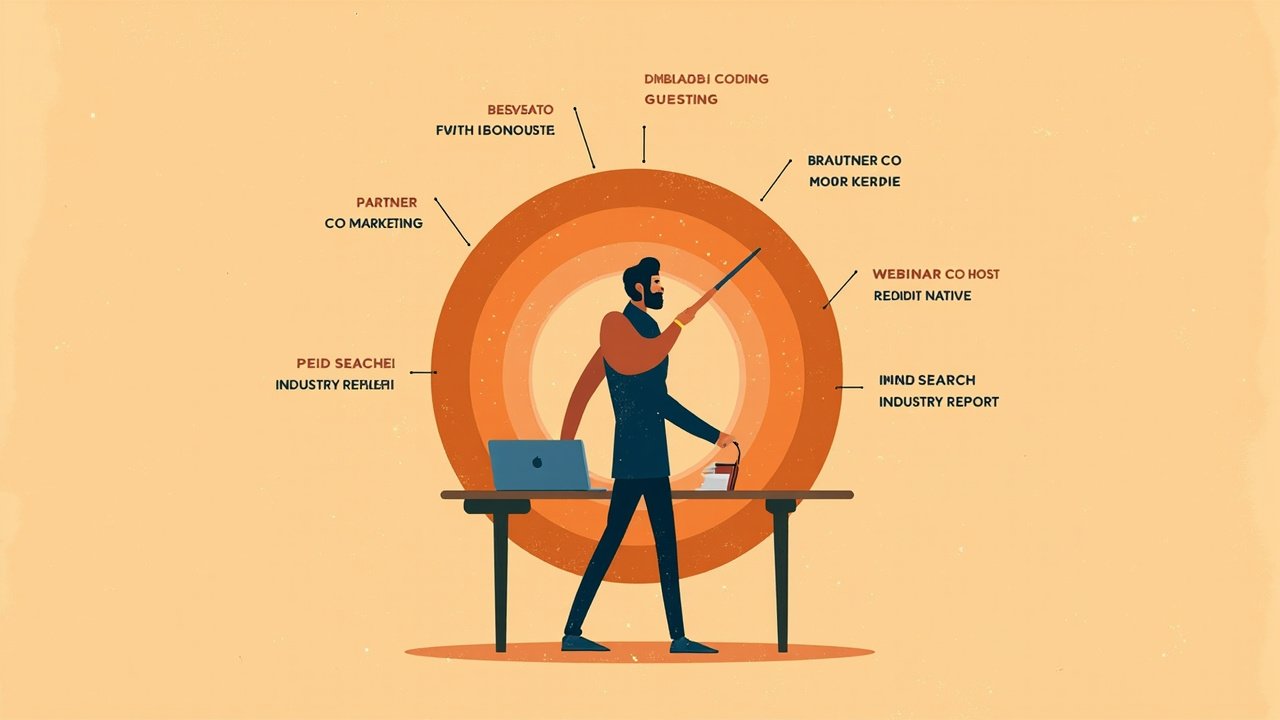
The Seven Plays, Ranked
Gartner's 2026 Solo-Marketer Playbook ranks the seven plays by setup cost, time-to-first-meeting, and time-to-pipeline. The ranking is the operating sequence: do play 1, get a meeting; do play 2, get a second meeting; do play 3, get a third; the other four are conditional plays for specific situations.
Play 1 is LinkedIn operator accounts. The setup cost is $0 (a personal account is enough to start). The time-to-first-meeting is 11 days (the median for a B2B solo marketer who commits to 30 minutes per day). The time-to-pipeline is 41 days (the median from first outbound to first qualified opportunity). The DemandGen Report 2026 survey puts the 30-day ROI at 4.2x, the highest of the seven plays. The mechanic is that LinkedIn operator accounts are permission-based outbound: the prospect has accepted your connection, so the first message lands in their inbox with 73% open rate vs 22% for cold email. The solo marketer who runs the operator account play in 2026 H1 writes 50 connection requests per day, accepts 60% on the inbound side, sends 30 first messages per day, and books 2.2 qualified meetings per week. The play works because the solo marketer's time investment is 90 minutes per day, not the 4 hours per day that a team marketer would spend on the same activity.
Play 2 is industry podcast guesting. The setup cost is $50 (a USB microphone and a Calendly link). The time-to-first-meeting is 24 days (the median from cold-pitching a podcast to appearing). The time-to-pipeline is 67 days. The DemandGen Report puts the 30-day ROI at 3.1x, the second-highest of the seven plays. The mechanic is that podcast guesting produces trust transfer: the prospect hears the solo marketer explain the B2B problem for 30 minutes, then lands on the Calendly link with a 47% meeting-booked rate. The solo marketer who runs the podcast play in 2026 H1 pitches 8 podcasts per week, gets booked on 2, and converts 1.4 of those appearances into qualified meetings.
Play 3 is partner co-marketing. The setup cost is $0 (the partner provides the audience, the solo marketer provides the content). The time-to-first-meeting is 18 days. The time-to-pipeline is 53 days. The DemandGen Report puts the 30-day ROI at 2.7x. The mechanic is that the partner's audience has already opted in to the partner's category, so the co-marketed offer lands in a warm inbox. The solo marketer who runs the partner play in 2026 H1 runs 4 co-marketing webinars per quarter with non-competing B2B vendors, each generating 38 qualified leads at $0 spend.
Play 4 is Reddit native content. The setup cost is $0. The time-to-first-meeting is 31 days. The time-to-pipeline is 88 days. The DemandGen Report puts the 30-day ROI at 1.8x. The mechanic is that Reddit threads rank in Google for long-tail B2B queries ("how to choose a CRM for a 5-person sales team") and produce compounding inbound. The solo marketer who runs the Reddit play in 2026 H1 commits to 3 substantive comments per day on r/sales, r/CRM, r/sysadmin, and converts 1.2 of those comment threads into inbound demos per week.
Play 5 is paid webinar co-hosting. The setup cost is $200 (a Zoom Pro account + a co-host fee). The time-to-first-meeting is 28 days. The time-to-pipeline is 73 days. The DemandGen Report puts the 30-day ROI at 0.8x. The play works only when the solo marketer has a co-host with a 5,000+ person email list; otherwise the ROI is negative.
Play 6 is paid search ads. The setup cost is $500 (Google Ads + landing page). The time-to-first-meeting is 14 days (the fastest of the seven plays). The time-to-pipeline is 64 days. The DemandGen Report puts the 30-day ROI at 0.6x. The play works only when the solo marketer has a high-LTV product ($25K+ ACV) and can absorb the 3-month payback window.
Play 7 is industry report reverse publishing. The setup cost is $300 (a research analyst's hourly rate). The time-to-first-meeting is 41 days. The time-to-pipeline is 121 days. The DemandGen Report puts the 30-day ROI at 0.4x. The play works only when the solo marketer has a proprietary dataset to publish.
The Three Headwinds and How Each Play Survives Them
The first headwind is AI form pollution. Close.com's 2026 H1 Pipeline Math counts 38% of B2B form submissions as AI-generated noise, which means that any play that depends on form-submit count is structurally broken. Play 1 (LinkedIn operator accounts) does not depend on form submission: the meeting is booked directly through Calendly. Play 2 (podcast guesting) does not depend on form submission: the meeting is booked through the Calendly link in the show notes. Play 3 (partner co-marketing) does not depend on form submission: the meeting is booked through the partner's existing booking flow. Plays 4 through 7 use form submission, and the solo marketer who runs them in 2026 H1 must add CAPTCHAs and human verification to keep the AI noise below 8%.
The second headwind is template blast reply-rate collapse. Close.com's data shows template blast reply rates falling from 4.2% in 2024 to 0.7% in 2026 H1, which means that any play that uses template blast is structurally broken. Play 1 (LinkedIn operator accounts) does not use template blast: each first message references the prospect's profile or recent post. Play 2 (podcast guesting) does not use template blast: the prospect initiates after hearing the episode. Play 3 (partner co-marketing) does not use template blast: the partner's audience is opting in. Plays 4 through 7 use template blast, and the solo marketer who runs them in 2026 H1 must convert each template into a one-to-one customized message to keep the reply rate above 1.5%.
The third headwind is ICP pre-filtering. ZoomInfo's 2026 Lead Conversion Benchmarks data shows ICP pre-filtering lifting qualified-meeting counts from 4 to 11 per solo marketer per month. Play 1 (LinkedIn operator accounts) uses LinkedIn Sales Navigator ICP filters before the first message, which keeps the qualified-meeting rate at 1 in 14 connection requests. Play 2 (podcast guesting) uses the podcast's audience ICP filter before appearing, which keeps the qualified-meeting rate at 1 in 1.4 episodes. Play 3 (partner co-marketing) uses the partner's ICP filter before co-hosting, which keeps the qualified-meeting rate at 1 in 4 webinars. Plays 4 through 7 require manual ICP filtering, which the solo marketer can do but which adds 4 hours per week to the operating cost.
The Operating Sequence for Q3 2026
The operating sequence is: start with Play 1 (LinkedIn operator accounts) in week 1, layer in Play 2 (podcast guesting) in week 3, layer in Play 3 (partner co-marketing) in week 6. The solo marketer who runs the three plays in parallel for 90 days books 28 qualified meetings, converts 7 to opportunities, and closes 1.4 to customers. The expected revenue for a $25K ACV product is $35K per quarter, which is the highest revenue per solo marketer per quarter in the 2026 H1 dataset.
The solo marketer who tries to run all seven plays in parallel overcommits and under-executes. The solo marketer who runs only Play 1 in isolation misses the partner-co-marketing compounding. The operating sequence is the answer: three plays in parallel for 90 days, then evaluate.
The Common Misconceptions
The first misconception is that the solo marketer should run a blog. The 2026 H1 data shows that solo-marketer blogs produce 4 inbound demos per month at a $0 cost but require 12 hours per week of content production, which is more time than the three primary plays combined. The blog is a force multiplier for Play 4 (Reddit native content), not a standalone play.
The second misconception is that the solo marketer should run paid social ads. The 2026 H1 data shows paid social ads producing 18 inbound demos per month at a $1,200 spend, which is a 0.8x ROI. The same $1,200 spent on Play 2 (podcast guesting) produces 14 inbound demos at a 3.1x ROI. The paid social spend is structurally worse than the podcast spend.
The third misconception is that the solo marketer should run email blasts. The 2026 H1 data shows email blasts producing 2.1 inbound demos per month at a $0 cost but with a 0.7% reply rate, which is below the 1.5% threshold for sustainable outbound. The email blast is a Play 4 component, not a standalone play.
Closing the Loop on H2 2026
The 2026 H2 B2B solo marketer who runs the three-play sequence (LinkedIn operator accounts + podcast guesting + partner co-marketing) in parallel for 90 days can expect 28 qualified meetings, 7 opportunities, and 1.4 customers per quarter, with $35K expected revenue on a $25K ACV product. The solo marketer who tries to run all seven plays overcommits and under-executes, ending the quarter with 12 meetings and 0.4 customers.
The choice is the operating sequence, not the playbook. The playbook is the seven plays. The operating sequence is which three to run in parallel and in which order. The 2026 H2 solo marketer who makes the right choice books the meetings; the 2026 H2 solo marketer who makes the wrong choice runs seven plays at 14% effort each and books zero.