
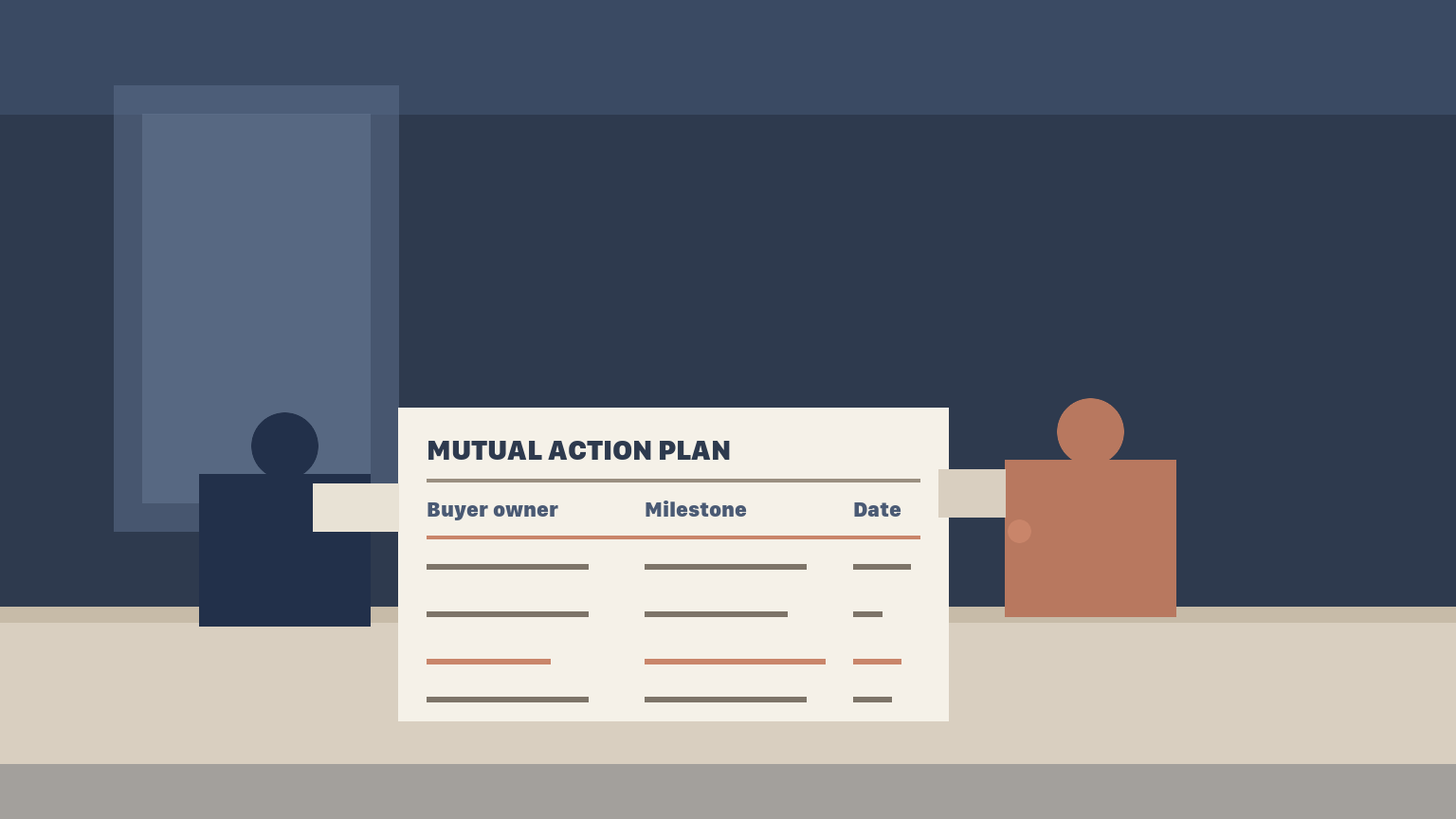
Mutual action plan governance is the documented control system that decides when a close plan becomes mandatory, what a buyer must actually commit to before the plan counts, who ratifies it, how its milestones are verified week by week, and what formally ends a deal that has stopped moving. In 2026, most revenue organizations already know what a mutual action plan is; the problem is that the plans exist as rep-owned documents with no entry rules, no buyer-side commitments, and no abandonment criteria, which is why forecast categories built on them keep failing — the same integrity problem a [deal risk scoring model](/blog/b2b-deal-risk-scoring-model-2026/) exposes one signal earlier. This article lays out the full governance model: entry criteria after qualification, buyer commitments with named owners and agreed dates, a manager ratification loop, a weekly verification cadence, and documented exit triggers that retire zombie deals before they distort the forecast.
The underlying economics have not changed, and they explain why governance rather than enthusiasm is the fix. Gartner's buying journey research has consistently found that a typical B2B purchase involves a buying group of roughly six to ten stakeholders and that buyers spend only about 17 percent of their total buying time meeting with any supplier's sales representatives. When face time is that scarce, the mutual action plan is not a courtesy document; it is the mechanism that makes a complex, multi-stakeholder purchase executable between the meetings. A plan that only lists the seller's next steps captures none of that value. A governed plan, in which every milestone carries a buyer-side owner and a date the buyer agreed to, becomes the shared operating record of the purchase itself.
The failure pattern is familiar to anyone who has run a pipeline review. A deal enters the commit category on the strength of a close plan that the rep wrote alone, with dates the rep estimated and milestones nobody outside the sales team has seen. Two weeks later the close date slips by exactly the length of the slip in the buyer's own internal approval cycle, which the seller never mapped. The deal does not die; it re-anchors to a new date and continues to occupy commit. Gong Labs' deal execution research has documented the underlying risk for years: deals that remain single-threaded, with only one buyer contact meaningfully engaged, close at materially lower rates than multi-threaded deals. An unratified close plan is usually single-threaded by construction, because it encodes one person's promises rather than the buying group's commitments — the gap a [champion enablement playbook](/blog/champion-enablement-playbook-2026/) is meant to close from the inside.
What mutual action plan governance actually governs
It helps to be precise about the object under management, because the phrase close plan is used loosely. The governed asset is a document with four properties. First, it is mutual: it records actions for the buying organization and the selling organization in the same view, and the buyer has seen and agreed to it. Second, it is milestone-structured: it decomposes the path to signature into verifiable events, such as security review completion, legal redline return, procurement committee dates, and executive sign-off, rather than a single hopeful close date. Third, it is owned on both sides: every milestone names a person, not a department. Fourth, it is falsifiable: the plan contains explicit evidence gates, so a milestone is either verified with observable proof or it is not, and there is no middle state called basically done.
Governance, then, is the set of standing rules around that asset. It defines the pipeline stage at which a plan becomes mandatory, the minimum commitments a plan must contain before it can support a forecast category, the authority who ratifies the plan, the cadence at which milestones are checked, and the conditions under which a deal is formally removed from the plan-governed category. None of these rules are novel individually. What is novel in most organizations is insisting on all of them simultaneously, in writing, with a named owner for the system itself. Alexander Group's work on late-stage deal execution points the same direction: revenue organizations that document late-stage exit criteria and run a standing deal-governance cadence report fewer slipped deals and more predictable close quarters than those that manage late-stage pipeline as a matter of rep craftsmanship.
Entry criteria: when a plan becomes mandatory
The first governance decision is the least glamorous and the most consequential: the pipeline moment at which a mutual action plan stops being optional. The workable standard in most B2B models is the boundary between qualification and proposal, or the equivalent stage in your methodology. Once a deal has cleared qualification — economic buyer identified, success criteria verbalized by the buyer rather than inferred by the seller, and a timeline the buyer has confirmed — the plan becomes a condition of advancing. Deals below that stage may carry a lightweight next-steps note; deals above it may not advance without a ratified plan.
Making entry criteria explicit removes the two classic failure modes. The first is the plan that never gets written until the deal is already late, at which point it functions as a post-mortem rather than a control. The second is the plan written only for the deals the rep is worried about, which selects on anxiety rather than on stage logic and leaves the confident deals unmanaged. A stage-gated entry rule is deliberately dumb in the best sense: it applies to every deal that crosses the line, including the ones everyone is sure will close, because those are precisely the deals whose failure surprises a forecast. The criteria also need an owner. Whoever runs sales operations owns the gate definition and the small CRM enforcement that keeps it honest, typically a required field or a stage-progression rule that asks for the plan reference at the proposal stage.
Buyer-side commitments: the difference between a plan and a wish list
The second control is the content standard for the plan itself, and it is stricter than most teams expect. A governed mutual action plan must contain, for every milestone, a named owner on the buying side, a date the buyer agreed to in a conversation the rep can point to, and the evidence that will count as verification. The test is brutal and simple: if a milestone cannot name a person outside the seller's organization, it is an internal to-do item, not a mutual commitment. Plans full of internal items — send the deck, update the quote, prepare the security documentation — are seller to-do lists wearing a plan's clothes.
This is where the buying-group research earns its keep. With six to ten stakeholders involved in a typical purchase, the plan is the only artifact that shows whether the seller has engaged the group or just its most available member. A governance review looks for the signature milestones of the buying organization's own process: the procurement committee date, the security review window, the finance approval step, the executive sponsor's calendar commitment. When those milestones are absent or undated, the plan is telling you, before the forecast does, that the deal is single-threaded. Gong Labs' execution research supports the inference directly: single-threaded deals close at materially lower rates, and close plans whose milestones reflect verified buyer-side commitments are associated with shorter late-stage cycles. The plan is therefore also a diagnostic instrument, and its content standard is what keeps the diagnostic honest.
The named ratifier and the weekly verification loop
The third control separates authorship from authority. The account executive writes the plan; the frontline sales manager ratifies it before it can support a commit or best-case category. Ratification is a short, scheduled conversation in which the manager tests each milestone for buyer ownership, agreed dates, and verification evidence, and either ratifies the plan or returns it with specific defects. Any later change to scope or close date requires re-ratification, which is what stops the quiet re-anchoring that destroys forecast accuracy. This division of labor matters because the rep is structurally optimistic; not through dishonesty, but because their income and identity are tied to the deal's momentum. The ratifier's job is to be the counterparty of that optimism.
Ratification starts the weekly verification loop, which is where the plan earns its keep between signatures. Once a week, in the standing deal review, each milestone on each governed plan is marked with exactly one of three states: verified, meaning the named evidence exists; slipped, meaning the agreed date passed without the event; or renegotiated, meaning the buyer-side owner agreed to a new date in a recorded conversation. The three-state discipline sounds bureaucratic until you watch what it replaces, which is the narrative status update — still tracking, they're close, legal is wrapping up — that cannot be audited. The verification loop also needs a decay rule: a milestone that slips for two consecutive weeks without renegotiation forces the deal out of its forecast category until the plan is re-ratified. Salesforce's State of Sales research keeps confirming why the cadence must be external to the rep's own calendar: representatives spend the larger share of their week on non-selling administrative work, and any control that depends on unprompted rep diligence between meetings will decay silently. The weekly loop is the heartbeat that makes silence visible.
Abandonment triggers: ending zombie deals cleanly
The final control is the one most teams never write down: the conditions under which a governed deal is formally exited. Three triggers cover most cases. The first is owner loss — the named buyer-side owner of two or more milestones leaves the account or the role, which resets the plan to draft until re-engagement produces new commitments. The second is repeated renegotiation — two scope or date renegotiations inside three weeks indicates a purchase that is not actually proceeding on the agreed path, and the deal moves to a lower forecast category while the buying group re-forms, and its treatment inside the [sales forecast cadence governance](/blog/b2b-sales-forecast-cadence-governance-2026/) review reverts to the standard rules. The third is structural slip — the signature date slips past a threshold set in policy, for example sixty days, without a corresponding renegotiation event, which means the plan and the forecast have diverged and the plan wins.
Writing the triggers down changes behavior in a way that exhortation never does, because it converts the hardest conversation in pipeline management — admitting a deal has stopped — from a personal judgment about a rep's competence into the routine execution of a published rule. The deal is not dead; it is unmanaged until it re-qualifies, and the distinction preserves both the relationship and the data. Zombie deals distort far more than the forecast: they occupy capacity that should cover live deals, they inflate coverage ratios that a governed [opportunity coverage model](/blog/b2b-opportunity-coverage-2026/) would have caught, and they teach the organization that dates are decorative. Alexander Group's late-stage governance findings run the same way — predictability comes from documented exit criteria and a standing cadence, not from tighter asking.
Standing the system up in ninety days
A pragmatic stand-up sequence fits in one quarter. In the first thirty days, publish the policy: the stage gate, the content standard for buyer-side commitments, the ratifier role, and the three-state verification vocabulary. Pilot on one segment rather than the whole company, and have managers ratify plans for the pilot segment's late-stage deals first. In the second thirty days, wire the CRM so the plan reference is requested at the gate and the three states are a field rather than a convention, and start the weekly verification review as a standing agenda item in existing pipeline meetings rather than a new meeting. In the final thirty days, run the first MAP-integrity audit: count the share of governed deals whose plans meet the content standard, the verified-milestone rate, the slip rate by milestone type, and the number of deals exited under the abandonment triggers. Those four numbers are the system's scorecard, and they are the numbers a CRO can defend in a board conversation about forecast discipline.
The honest summary is that mutual action plan governance is not a productivity tactic; it is an integrity mechanism for late-stage revenue. The research backdrop is stable and well known — scarce buyer face time, multi-stakeholder committees, the structural fragility of single-threaded deals, and the administrative load that erodes unmanaged commitments between meetings. What separates predictable revenue organizations from optimistic ones is not that they know these things; it is that they wrote the rules down, named the ratifiers, verified the milestones every week, and retired the deals that stopped moving. That is the whole model, and it fits on one page — which is exactly why it survives contact with a real quarter.