
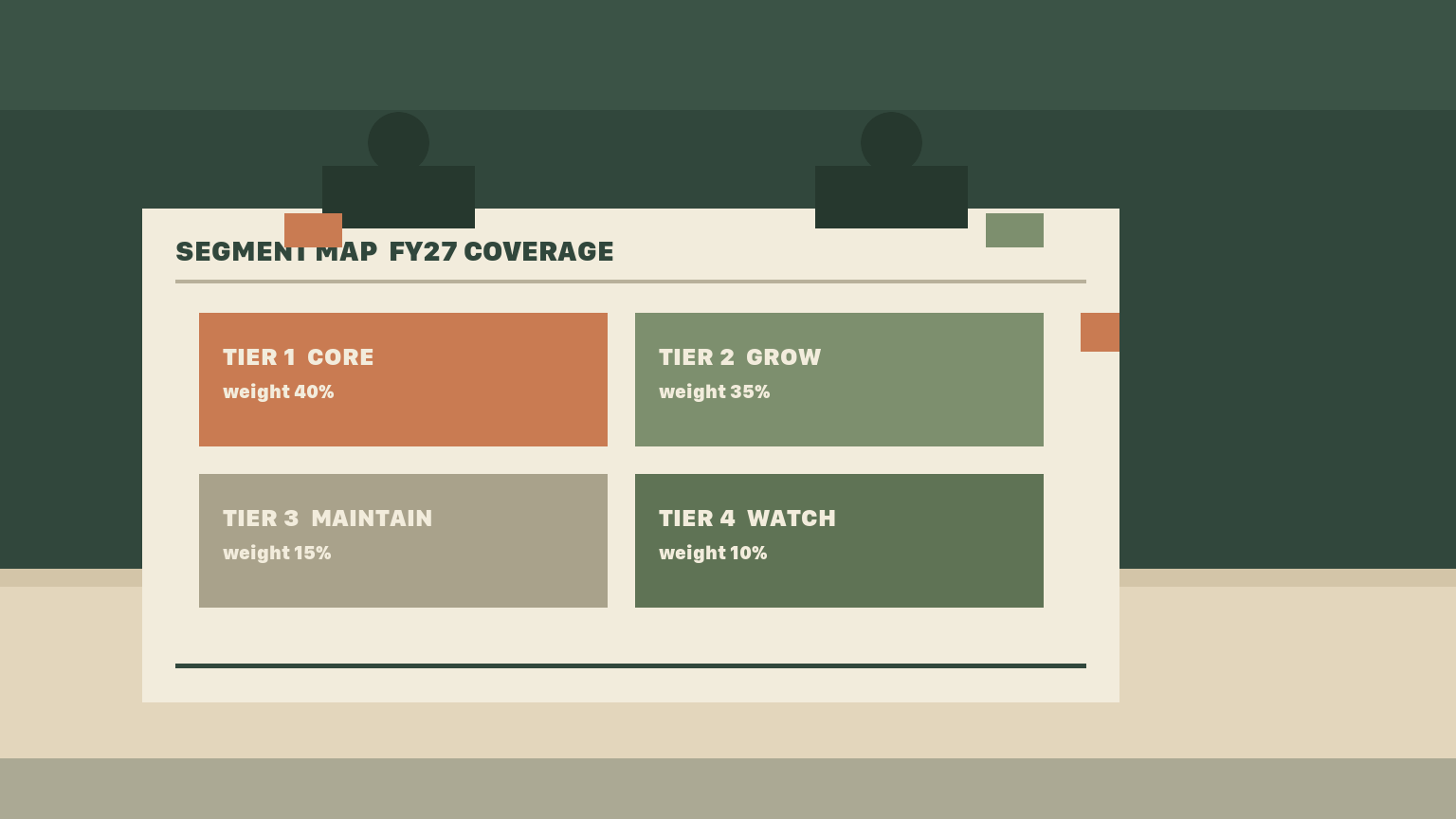
B2B sales segmentation governance is the documented control system around the segmentation model itself: weighted firmographic, behavioral, and economic criteria with explicit thresholds; a named ratifier for any change to criteria, weights, or boundaries; migration rules that govern how accounts cross segment lines without gaming; a standing quarterly review of segment mix, migration volume, and exception rate; and a binding contract that ties segment definitions to coverage models, pricing bands, and territory design. The distinction matters because segmentation is usually treated as a one-time strategy exercise — a deck from two years ago whose tier names survive in CRM fields while the underlying logic has quietly stopped describing the business. This article sets out the governance model that keeps segmentation a living operating asset: what the model must specify, who owns changing it, how accounts migrate, what the review cadence examines, and how segment changes propagate into coverage, pricing, and territories in the same governed motion.
The evidence base for governing this asset is consistent across the major research houses. Alexander Group's coverage work holds that coverage models should be derived from segment economics — opportunity value, cost-to-serve, and buying behavior — rather than patched reactively, and that organizations recalibrating segmentation on a scheduled annual or biannual cycle avoid coverage drift as accounts migrate. Gartner's ideal customer profile guidance finds that disciplined, evidence-based ICP definition produces better targeting efficiency and higher-quality pipeline than intuition or inherited account lists, and, critically, that the definition decays without periodic review. McKinsey's granular growth research shows that companies that segment finely enough to reallocate resources toward the highest-opportunity segments grow faster than peers that spread coverage evenly across legacy boundaries. And Forrester's ABM analysis reports that tiered account segmentation governed by explicit documented criteria outperforms ad-hoc, rep-nominated lists on account-level outcomes. Four independent research programs converge on the same conclusion: segmentation creates value only while it is maintained, and maintenance is a governance problem, not a modeling problem.
The governed model: weighted criteria with explicit thresholds
A governed segmentation model is a scoring model written down in one artifact. It specifies the criteria families and their weights — typically a firmographic family covering industry, employee band, and revenue; an economics family covering opportunity value, cost-to-serve, and margin potential; and a behavioral family covering engagement intensity, product fit, and buying-cycle signals. It specifies the thresholds that map composite scores to segments. And it specifies, for each segment, the entitlements that flow from membership — deliberately distinct from the post-sale service tiers that a [customer success tiering](/blog/b2b-customer-success-tiering-2026/) model governs: the coverage model that applies, the pricing band that applies, the service levels, and the investment tier for marketing programs. The artifact is short — a page plus an appendix — and its defining property is that a stranger with the data could reproduce the segmentation exactly.
That reproducibility test is what separates a governed model from the folk segmentation most organizations actually run. In the folk version, an account is strategic because a rep built a relationship three years ago, or because the logo would look good on a press release, and the tiering field in the CRM accretes these stories without audit. Gartner's ICP findings apply directly: intuition-based definitions decay fastest, because every account owner's intuition points somewhere slightly different. The weighted model does not eliminate judgment; it disciplines where judgment is allowed to operate — in choosing criteria, weights, and thresholds through a ratified process — and where it is not: in deciding whether this particular account gets the enterprise coverage package this quarter.
The named ratifier: who is allowed to change the model
The second control is authority. Any change to the segmentation model — a criterion added or retired, a weight moved, a threshold shifted — requires a named ratifier: typically the RevOps lead for operational changes, with CRO-staff sign-off for changes that move material revenue between segments. The ratification record is short but mandatory: what changed, why, on what evidence, effective when, and which downstream contracts — coverage assignments, pricing bands, territory alignments — the change triggers. This is deliberately heavier than the alternative, which is a field edit in the CRM made by whoever noticed the annoyance first. Model changes are cheap to make and expensive to absorb; the ratifier exists to make the absorption cost visible before the change ships.
The ratifier role also protects the model from its most common corruption: exception accretion. Every account that gets manually re-tiered without a rule is a small repeal of the model, and enough repeals make the model decorative. The governance answer is a published exception budget — a maximum share of accounts, typically under five percent, that may sit outside their scored segment at any time, each with an owner, a rationale, and an expiry. When the budget is full, the next exception requires either retiring an old one or ratifying a model change. The budget converts exception pressure, which is otherwise infinite, into a scarce resource that forces the real question: is this account special, or is the model wrong?
Migration rules: how accounts cross boundaries without gaming
The third control governs movement. Accounts change segment for real reasons — growth, churn, acquisition, strategy shifts — and the migration path must be rule-based enough to resist gaming and humane enough to survive contact with customers. The workable standard is persistence plus ratification: an account migrates when its composite score crosses a boundary and stays crossed for two consecutive quarters, or immediately when a ratified exception applies, with transition treatment defined in advance. Transition treatment is the underrated half of the rule: when an account moves up-tier, its entitlements phase in on a published schedule; when it moves down-tier, the coverage change is buffered — the named account team keeps ownership through the current renewal, for example — so that migration governance does not become an excuse for whipsawing customers.
Migration analytics are what make the rule auditable. Each quarterly review examines how many accounts migrated in each direction, at what pace, and whether migration correlates with the outcomes the model predicts — do accounts that migrated up actually grow coverage-worthy revenue? A model whose migrations never correlate with outcomes is mis-specified, and the review is where that gets caught. McKinsey's granular growth findings frame the stakes: resource reallocation toward high-opportunity segments is where the growth premium comes from, and reallocation is only possible when migration is governed rather than negotiated account by account.
The quarterly review: examining the model, not just the accounts
The fourth control is the standing cadence. Once a quarter, a fixed group — the ratifier, sales operations, the territory and pricing leads, and a rotating frontline sales manager — reviews a fixed agenda: segment mix versus plan, migration volume and direction, exception budget consumption, coverage cost per segment, and win and churn rates by segment against the model's assumptions. The annual recalibration, following Alexander Group's cycle, then uses four quarters of this evidence to re-ratify criteria, weights, and thresholds or to explicitly re-affirm them. The quarterly review is deliberately operational — it catches drift while it is still cheap; the annual recalibration is deliberately structural — it lets the model chase the market rather than the last quarter's anecdotes.
Segment-to-coverage binding: one change, one motion
The fifth control is the binding contract, and it is the one that makes the other four worth their cost. In most organizations, segmentation, coverage, pricing bands, and territories live in different systems, owned by different people, refreshed on different calendars — so a segmentation change takes effect in the CRM immediately and in the coverage model nine months later, if ever. The governed alternative states the rule once: segment definitions are the upstream contract. When the model changes through ratification, the downstream entitlements change in the same motion — coverage assignments inherit the new segment entitlements on the published transition schedule with quota treatment following the same governed motion as [quota allocation governance](/blog/b2b-quota-allocation-governance-2026/), pricing bands re-map on the next quote, and territory boundaries absorb the account movement at the next scheduled alignment governed by a [territory realignment protocol](/blog/b2b-territory-realignment-protocol-2026/) rather than through one-off exceptions.
This binding is also what keeps segmentation honest. When segment changes automatically carry coverage and pricing consequences, the organization suddenly cares whether the model is right, because a mis-tiered account now mis-allocates a named team and a price band, not just a label. Forrester's tiered-criteria findings in ABM programs show the pattern at program scale: explicit, documented tier criteria with real entitlements behind them outperform ad-hoc lists precisely because the criteria discipline what the program invests. The binding rule turns segmentation from descriptive metadata into the allocation system it was always meant to be.
Standing the B2B sales segmentation governance system up in ninety days
The stand-up sequence fits a quarter. In the first thirty days, write the model down: current criteria, weights, thresholds, and entitlements as they actually operate today, including the folk rules — the account everyone knows is strategic for reasons nobody wrote. Reverse-engineering the de facto model is more honest than pretending the deck from two years ago governs. Publish the ratifier role, the exception budget, and the migration rule in the same artifact. In the second thirty days, baseline the dynamics: score the account base against the written model, count the current de facto exceptions, and measure migration that has happened silently over the past year. The gap between the written model and the CRM's actual tiering is the governance backlog, and it should be sized and reported, not quietly reconciled. In the final thirty days, stand up the quarterly review with its fixed agenda and run the first session on the baseline data, then schedule the first annual recalibration. The output of the first review is rarely a model change; it is usually the discovery that the model nobody admitted to running is the one that has been allocating the capacity your [sales capacity model](/blog/b2b-sales-capacity-model-2026/) was built around.
The closing perspective is that segmentation is the quiet master variable of a revenue organization. It decides who gets called, at what price, by whom, with what support — which means every weakness in segmentation governance propagates into coverage cost, price realization, and territory fairness. The research consensus — derived coverage from segment economics, disciplined ICP maintenance, granular reallocation, documented tier criteria — describes a system that pays for itself in allocation quality alone. What the research cannot supply, and this article has tried to, is the plumbing: the ratifier, the exception budget, the persistence rule, the fixed agenda, and the binding contract that makes the model matter. None of it is sophisticated; all of it is governance. The test of whether you need it is one question asked of three account owners about the same account, and if you already know the answers will differ, you already know your next RevOps project.