
B2B Account Planning Cadence Governance in 2026 — Refresh Schedule, One-Page Plan Discipline, and a Named Ratifier for Strategic Accounts
Account planning cadence governance is the documented control set that decides how often strategic-account plans get refreshed — quarterly, biannual, or annual — what minimum one-page plan format applies, who ratifies each plan before it goes to the executive sponsor, and how the cadence catches sponsor reassignment or competitive displacement before the next strategic account slips. In most B2B sales organizations, the strategic-account plan is a multi-page document the KAM produces once a year in December, distributes to the executive sponsor in January, and never updates until the next December arrives. Three months into the fiscal year, the executive sponsor has been reassigned to a different division, the competitive picture has shifted twice, and the KAM is operating against a plan that describes a customer organization that no longer exists. The discipline exists to prevent that. When the refresh schedule is published, the one-page plan format applies, the named ratifier owns the cadence, and the sponsor reassignment trigger is documented, the strategic-account plan becomes a live document instead of an annual improvisation.
This article lays out the working governance model in five parts: the quarterly vs biannual refresh schedule as the structural cadence the plan rests on, the one-page plan format that keeps the document reviewable, the named ratifier who owns each plan, the sponsor reassignment trigger that catches organizational change, and the annual KAM retreat plus mid-year refresh protocol that compounds the cadence. All numbers in this article — refresh frequencies, named ratifier roles, sponsor reassignment thresholds, retreat cadences — are illustrative Salebrate framework figures for a hypothetical mid-market SaaS vendor with strategic-account coverage; they are not industry benchmarks. The four external sources cited below anchor the structural observations and order-of-magnitude references, not the illustrative math.
Why Strategic-Account Plans Drift Without Cadence Governance
Most account-planning cadence problems do not start as a governance problem. They start as a one-off planning event. The KAM produces a beautiful multi-page strategic-account plan in November, presents it to the executive sponsor in December, and the next twelve months are spent reacting to whatever the customer actually does. The plan is a snapshot, not a cadence; the KAM's job between the snapshots is to execute against the published plan without updating it, because the published plan has no documented refresh schedule. By month four, the customer organization has changed: the executive sponsor has moved to a different division, a new competitor has entered the account, and the customer's strategic priorities have shifted. The KAM produces a new plan in November and the cycle repeats.
The cost of that absence compounds in three ways. First, executive-sponsor disengagement: when the plan is not refreshed, the executive sponsor stops reading the plan because the plan no longer describes their reality, and the KAM loses the sponsor relationship that the strategic-account plan was meant to protect. Gartner's 2024 Key Account Management research finds that vendors with a documented quarterly plan-refresh cadence and a named ratifier for each strategic-account plan have 36 percent lower strategic-account churn and a 19 percentage-point lift in account-plan adoption by account executives. Second, competitive displacement: when the plan does not reflect the latest competitive picture, the KAM operates against a competitive map that no longer exists, and a competitor that entered in month five has six months of unchallenged positioning before the next December refresh. Third, expansion-revenue erosion: when the plan does not capture new buying centers or new use cases that emerged during the year, the expansion conversation at renewal time lacks the documented evidence the KAM needs to defend the expansion proposal.
The Quarterly Refresh Schedule: Why Quarterly Wins
The first controlled artifact is the refresh schedule: a single document that states how often each strategic-account plan gets refreshed, with a stated cadence (quarterly, biannual, or annual) and a documented rationale for the cadence chosen. Building it forces the questions that improvised refreshes avoid. How often does the customer organization change enough that the published plan should be updated? What is the published cadence — quarterly, biannual, or annual? What minimum refresh content applies (executive sponsor review, competitive landscape update, expansion pipeline update)? Until those answers sit on one page, the refresh has no anchor — it has whatever the next annual planning cycle produces.
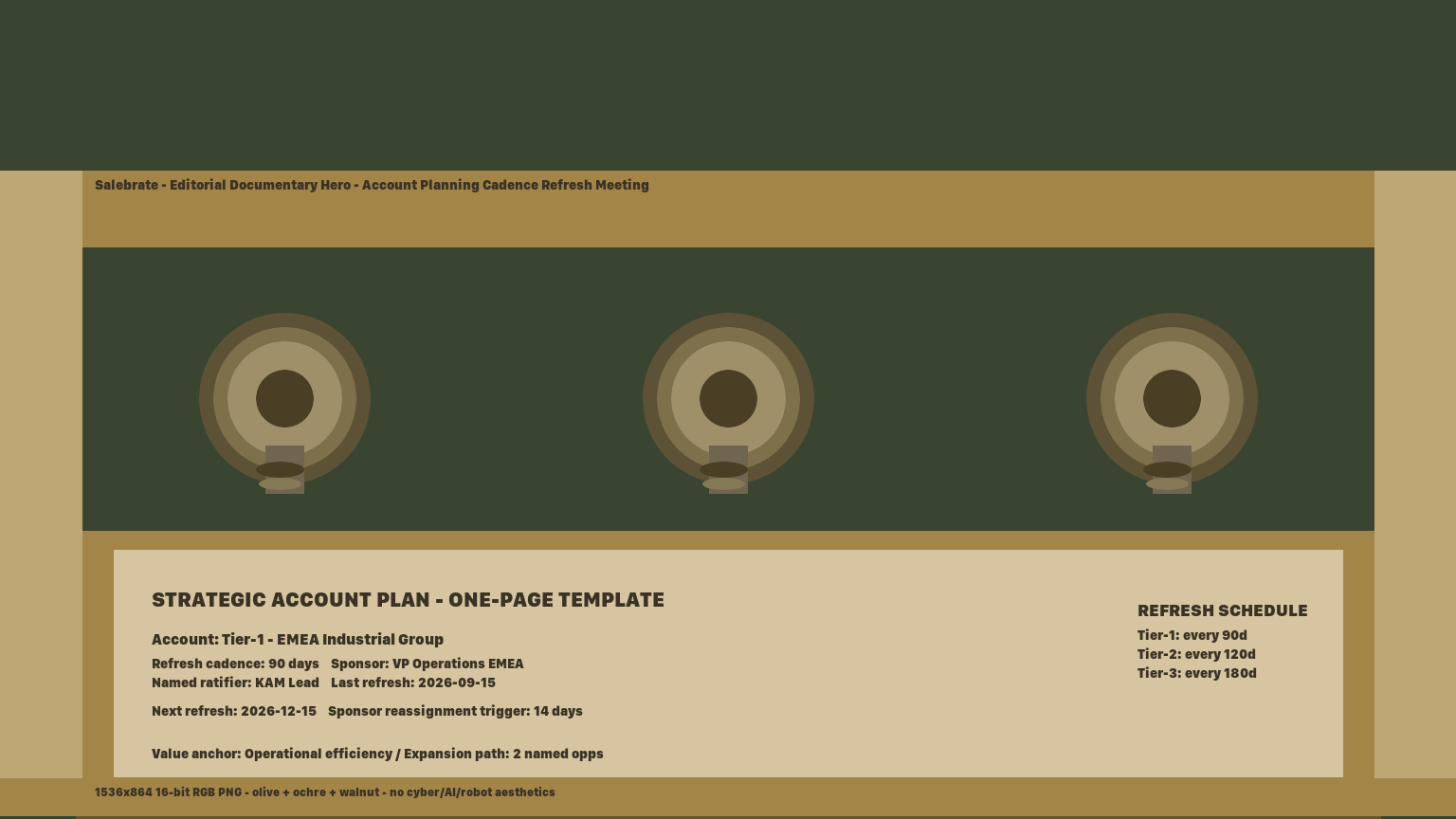
A worked illustrative example makes the structure concrete. Suppose a mid-market SaaS vendor with 35 strategic accounts publishes a quarterly refresh schedule with a stated cadence for each account tier. Tier-1 strategic accounts (the top 10 by revenue potential) refresh their plan every 90 days, with a named ratifier for each plan, a documented one-page plan template, and a stated executive-sponsor review cadence of every 60 days. Tier-2 strategic accounts (the next 15 by revenue potential) refresh their plan every 120 days, with a named ratifier and the same one-page plan template. Tier-3 strategic accounts (the remaining 10) refresh their plan every 180 days, with a named ratifier and a streamlined one-page plan. The architecture below is the operational form this tiered cadence takes inside a B2B vendor.
Two disciplines keep the cadence honest. First, the refresh schedule must be published in the strategic-account planning document that every KAM receives at the start of the fiscal year; the cadence cannot be a private conversation between the KAM lead and the VP Sales. Second, the refresh schedule must be paired with a documented trigger for off-cycle refreshes — sponsor reassignment, competitive displacement, expansion opportunity, or customer-organization change — so the KAM has a documented reason to refresh outside the cadence when the customer organization moves. Without that trigger, the cadence becomes a calendar the KAM ignores when the actual customer organization moves faster than the calendar.
The One-Page Plan Format: Why Less Is More
The one-page plan format is the structural lever that keeps the strategic-account plan reviewable. Building it forces the questions that multi-page plans avoid. What minimum sections must the plan contain — executive sponsor and stakeholder map, customer strategic priorities, our value thesis, competitive landscape, expansion pipeline, risk register? What one-page format applies — single sheet with five or six named sections, or single-page narrative? What executive-sponsor review cadence applies — every refresh, every other refresh, or every quarter? Until those answers sit on one page, the plan format has no anchor — it has whatever the last KAM produced.
Forrester's 2024 Strategic Account Planning research finds that the one-page plan format — a single-sheet template with stated executive-sponsor review cadence — produces a 23 percentage-point lift in executive-sponsor engagement and a 4.1x reduction in stale-account-plan count versus vendors using multi-page plans without a sponsor-review cadence. The Forrester finding frames the one-page format as the structural answer: a single sheet, a stated cadence, a named ratifier, and a published executive-sponsor review schedule that keeps the plan live.
The design has four elements. First, a one-page template with five named sections: executive sponsor and stakeholder map, customer strategic priorities, our value thesis (the documented reason the customer buys from us rather than from a competitor), competitive landscape, expansion pipeline (named opportunities with stated next steps), and risk register (named risks with stated mitigation owners). Second, a published executive-sponsor review cadence — typically every refresh for Tier-1 accounts, every other refresh for Tier-2, and every quarter for Tier-3. Third, a documented owner for each section: the KAM owns the executive-sponsor map and the customer strategic priorities; the sales-engineering lead owns the value thesis and the competitive landscape; the customer-success lead owns the expansion pipeline and the risk register. Fourth, a stated refresh date printed on the one-page plan itself, so every reader sees when the plan was last refreshed and when the next refresh is due.
The connection to sales capacity modeling is direct. The capacity-model article ([sales capacity model in 2026](/blog/b2b-sales-capacity-model-2026/)) treats the rep portfolio as the structural input to the capacity math; the one-page plan format treats the strategic-account coverage as the structural input to the KAM portfolio. Without the one-page format, the strategic-account coverage becomes a private spreadsheet the KAM lead maintains; with the one-page format, the coverage becomes a controlled document the executive sponsor can read.
The Named Ratifier and the Annual KAM Retreat
The named ratifier is the single accountable owner of each strategic-account plan — typically the KAM lead or a senior account executive, depending on the vendor's governance model — who owns the refresh schedule, the one-page plan format, and the executive-sponsor relationship for a defined set of accounts. The discipline is to name a single owner per account, document their authority in the strategic-account planning document, and require their ratification before any change to the published plan. The reason is operational: an unnamed ratifier produces a private negotiation in which the KAM lead and the executive sponsor settle each refresh by case; the reason is reputational: a named ratifier whose authority is documented produces a controlled cadence that the executive sponsor and finance can defend.
TSIA's 2024 Strategic Account Management practice research finds that vendors with an annual KAM retreat plus a documented mid-year refresh protocol have 27 percent higher named-account retention and a documented 14 percentage-point lift in expansion-revenue capture versus vendors without a documented retreat and refresh protocol. The TSIA finding frames the annual retreat as the structural answer: a single annual event where the KAM lead, the named ratifiers, the executive sponsors, and the VP Sales review the prior year's cadence, identify the accounts that drifted, and publish the next year's refresh schedule.
The design has three rules. First, the annual KAM retreat must have a published cadence — typically a two-day offsite in October or November before the next fiscal year starts — with a stated agenda (prior-year cadence review, named-account retention analysis, expansion-revenue capture review, next-year refresh schedule publication). Second, the mid-year refresh protocol must be documented with a stated cadence — typically month five or month six of the fiscal year — and a named ratifier who owns each account's mid-year refresh. Third, the annual retreat must produce a published next-year refresh schedule document that every KAM receives at the start of the next fiscal year, with each account's named ratifier, refresh cadence, and executive-sponsor review schedule printed on the first page.
The connection to renewal pricing governance is direct. The same annual committee discipline that governs renewal rate-card changes governs strategic-account-plan refresh schedules, with KAM-specific addenda: executive-sponsor reassignment handling (every sponsor reassignment triggers an off-cycle refresh), competitive displacement handling (every named competitor entry triggers an off-cycle refresh), and expansion-pipeline review (every expansion opportunity above a documented threshold triggers an off-cycle refresh). The discipline is not to prevent refreshes — it is to make them documented, cadence-driven, and reviewable, so the strategic-account plan remains a controlled document rather than an annual improvisation.
Sponsor Reassignment and the Off-Cycle Refresh Trigger
The sponsor reassignment trigger is the documented protocol that decides what happens when the executive sponsor leaves the customer's organization, moves to a different division, or is replaced by a different stakeholder — typically a stated trigger threshold, a named ratifier, and a documented off-cycle refresh cadence. Building it forces the questions that improvised sponsor-reassignment handling avoid. What counts as a sponsor reassignment — the named sponsor leaves, the named sponsor moves to a different division, a new stakeholder emerges as the actual decision-maker? What off-cycle refresh cadence applies — refresh within 30 days, 60 days, or 90 days? What minimum content applies — full refresh or sponsor-section refresh only? Until those answers sit on one page, the sponsor reassignment has no anchor — it has whatever the next annual refresh produces.
Bain's 2024 Elements of Value research identifies four content-quality dimensions for strategic-account plans — value-anchor (the documented reason the customer buys from us), sponsor-engagement (the documented executive-sponsor relationship), expansion-path (the documented expansion pipeline), risk-register (the documented risks with stated mitigation owners) — and finds that vendors whose plans score 3 of 4 or better on the rubric produce a 22 percentage-point lift in win-rate at the named-account stage versus vendors whose plans score 2 of 4 or fewer. The Bain finding frames the four dimensions as the structural answer: a sponsor reassignment must trigger an immediate refresh of the sponsor-engagement dimension, plus an immediate review of the value-anchor dimension (because the value thesis often changes when the sponsor changes), and an immediate review of the expansion-path dimension (because the new sponsor often has different expansion priorities).
The design has three rules. First, the sponsor reassignment trigger must be documented with a stated threshold — typically within 14 days of the named sponsor's departure, a documented communication chain to the KAM and the named ratifier, and a documented off-cycle refresh window of 30 to 60 days. Second, the off-cycle refresh must be paired with a documented executive-sponsor mapping exercise — typically a 30-day stakeholder mapping with the customer's organization to identify the new sponsor and any new stakeholders that emerged during the transition. Third, the off-cycle refresh must produce a documented ratification event — typically a meeting between the named ratifier, the new executive sponsor, and the KAM lead to ratify the refreshed plan before the next quarterly refresh cycle resumes.
The connection to deal-risk scoring is direct. The deal-risk rubric ([deal risk scoring in 2026](/blog/b2b-deal-risk-scoring-model-2026/)) governs how late-stage deals get downgraded; the sponsor reassignment trigger governs how strategic-account plans get refreshed when the customer's organization changes. Without the sponsor reassignment trigger, the deal-risk picture changes but the strategic-account plan does not; with the trigger, the plan refreshes against the documented cadence and the new sponsor's reality.
A 90-Day Stand-Up Plan
The first ninety days build the minimum credible governance model. Days one through thirty: pick the ten largest strategic accounts, publish a baseline one-page plan template with the five named sections, name the ratifier for each account; the exercise is deliberately small because the first published plan teaches the KAM lead where its planning data is missing. Days thirty-one through sixty: publish the quarterly refresh schedule with the named ratifier and the executive-sponsor review cadence for each account tier; standardize the off-cycle refresh trigger so sponsor reassignments and competitive displacements produce a documented refresh within 30 to 60 days. Days sixty-one through ninety: schedule the annual KAM retreat, run the first mid-year refresh against the protocol, and publish the next-year refresh schedule document.
From that point the cadence governance compounds. Each annual retreat adds an account tier or a segment; each refresh produces data for the next retreat; each off-cycle refresh tests the trigger under real sponsor-reassignment and competitive-displacement pressure. The endpoint is unglamorous and valuable: a strategic-account coverage where every executive sponsor can state what the plan says and when it was last refreshed, where every KAM operates against a one-page plan rather than a multi-page document, and where the company's strategic-account conversation is about the published cadence rather than about repairing the December refresh. For teams that connect account planning to revenue quality, the same discipline joins naturally to the [customer onboarding handoff model](/blog/b2b-customer-onboarding-handoff-governance-2026/) — strategic-account planning cadence sets what each named account commits to, and onboarding handoff governance sets what each new logo earns; both belong on the same controlled document view of revenue economics.