
B2B Quota Allocation Governance in 2026 — Distribution Math, Tier Rules, and a Named Ratifier for the Annual Reset
Quota allocation governance is the documented control set that decides how the annual plan flows to each team, region, and segment — top-down vs bottom-up reconciliation, tier rules for new hires and territory moves, a named executive ratifier, a retreat trigger, and a mid-year rebalance protocol — owned, versioned, and reviewed before the new fiscal year starts rather than improvised each time the VP Sales and the regional leads cannot agree. In most B2B sales organizations, the annual quota allocation lives in a single spreadsheet that the VP Sales rewrites in October, distributes in November, and never touches again until a territory move or a senior-rep negotiation forces a mid-year rebalance that nobody planned for. Three months into the fiscal year, every regional lead has a private version of the allocation that the published version no longer reflects, finance cannot reconcile the variable-cost line to the published plan, and the reps who are hitting their numbers in regions with generous allocations have a structural advantage over reps in tighter regions that the company cannot defend in an audit. The discipline exists to prevent that. When the allocation formula is published, the tier rules are documented, the named ratifier owns the annual reset, and the mid-year rebalance protocol catches drift before it compounds, the quota allocation becomes a controlled instrument instead of an annual improvisation.
This article lays out the working governance model in five parts: the top-down vs bottom-up reconciliation as the structural math the allocation rests on, the tier rules that govern new hires and territory moves, the named executive ratifier that owns the annual reset and the mid-year rebalance, the retreat trigger that catches drift before it compounds, and the quarterly allocation committee that publishes the minutes. All numbers in this article — allocation percentages, tier-rule behavior, rebalance thresholds, retreat-trigger criteria — are illustrative Salebrate framework figures for a hypothetical mid-market SaaS vendor; they are not industry benchmarks. The four external sources cited below anchor the structural observations and order-of-magnitude references, not the illustrative math.
Why Quota Allocations Drift Without Governance
Most quota allocation problems do not start as a governance problem. They start as a planning conversation. The VP Sales wants to give the EMEA team a stretch number because the EMEA pipeline is growing; three months into the year, the EMEA team is missing the stretch number, and the regional lead is asking for a reallocation that nobody can defend because the original stretch was a private conversation. Or the allocation starts as a save: a senior rep in APAC threatens to leave, the APAC allocation is quietly rewritten to keep them, and the next budget cycle reveals that the same concession was extended to two other senior reps in the same region. The root cause is not weak sales leadership; it is the absence of a documented allocation formula that states, in advance, who owns the allocation and under what conditions it can change.
The cost of that absence compounds in three ways. First, attainment distribution distortion: when tier rules are not documented, new hires and territory moves get bespoke allocations that cluster around the loudest account managers, and the published attainment bands no longer reflect what the company actually expects from a rep population. Alexander Group's 2024 sales-performance benchmark finds that vendors with a documented top-down vs bottom-up reconciliation have 32 percent lower mid-year rebalance variance than vendors that rely on a single-method allocation; the reconciliation is the structural lever that decides whether the annual plan lands as a designed instrument or an improvised redistribution. Second, retention-quality drift: when the allocation is rewritten mid-year to keep individual reps or regional leads, those reps learn that the allocation is negotiable, and the next mid-year negotiation becomes a structural expectation rather than an exception. Third, forecast instability: when the allocation is shaped by unannounced exceptions, finance cannot anchor the budget on the published plan, and the variable cost line becomes a trailing indicator of negotiation outcomes rather than a leading indicator of attainment.
Top-Down vs Bottom-Up Reconciliation: The Allocation Math
The first controlled artifact is the allocation formula: a single document that states how much of the annual plan flows to each team, region, and segment, with a documented reconciliation between the top-down allocation (set by the VP Sales and finance) and the bottom-up input (set by each regional lead). Building it forces the questions that improvised allocations avoid. What fraction of the annual plan does each region carry? How is the regional allocation derived from account count, account revenue potential, and territory maturity? How does the bottom-up input from each regional lead reconcile against the top-down allocation, and what happens when they disagree? Until those answers sit on one page, the allocation has no anchor — it has whatever the last VP Sales settled for.
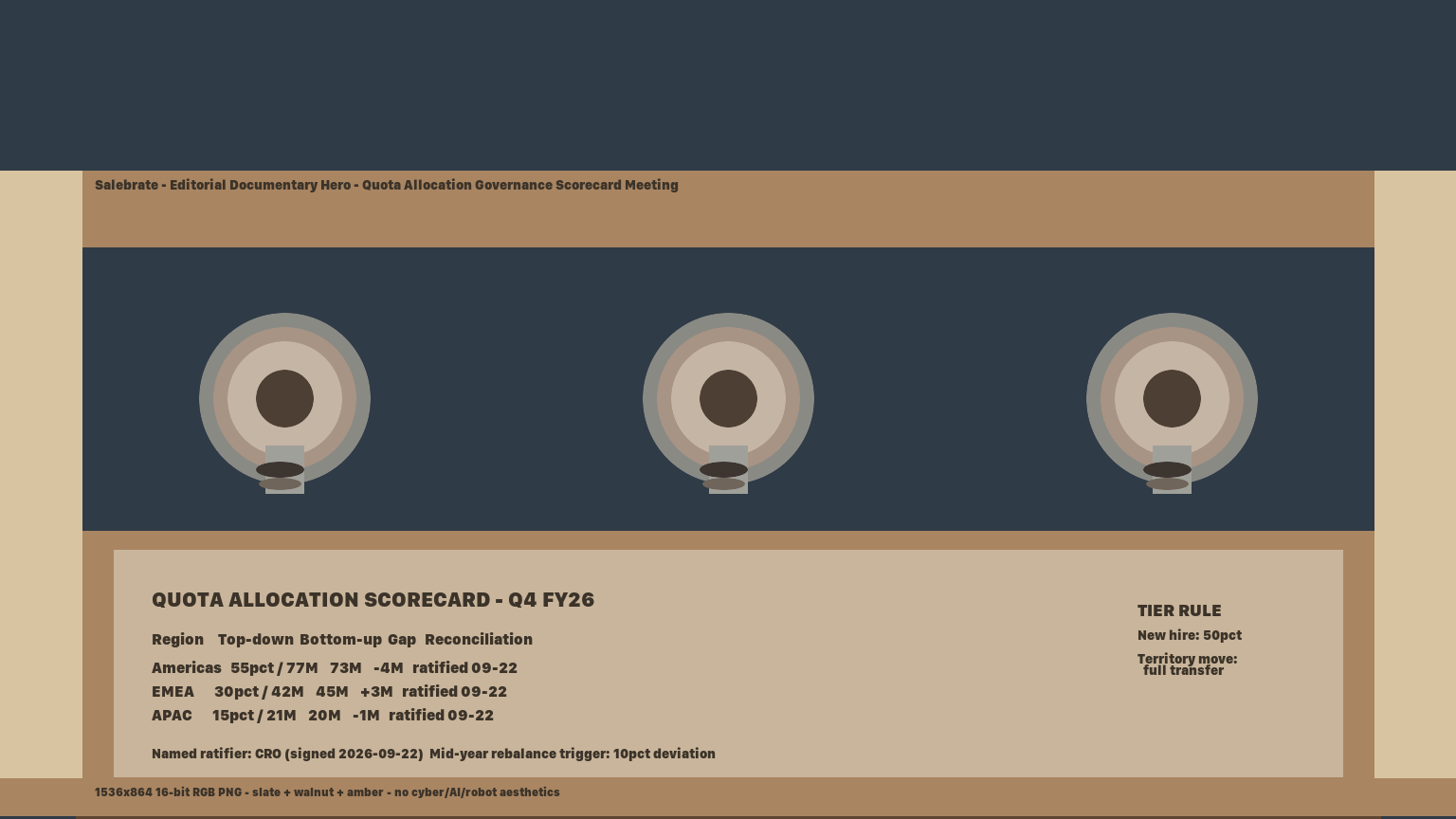
A worked illustrative example makes the structure concrete. Suppose a mid-market SaaS vendor with $120M ARR publishes an annual plan of $140M new-logo bookings for the next fiscal year. The top-down allocation, set by the VP Sales and finance, states that 55 percent of the plan flows to the Americas region, 30 percent to EMEA, and 15 percent to APAC; the allocation is derived from the prior year's regional attainment distribution and the published account-count and pipeline-coverage targets. The bottom-up input, set by each regional lead, states that the Americas team can commit to $73M (versus the top-down $77M), EMEA can commit to $45M (versus the top-down $42M), and APAC can commit to $20M (versus the top-down $21M). The reconciliation produces a documented gap of $4M below the top-down plan in the Americas and a documented over-commit of $3M in EMEA; the allocation committee ratifies the gap, documents the regional lead's rationale, and publishes the final reconciled allocation as the published plan. The architecture below is the operational form this reconciliation takes inside a B2B vendor.
Two disciplines keep the allocation honest. First, the allocation formula must be versioned like a controlled document: when the regional strategy, the territory map, or the segment mix changes, the allocation is reissued; regional leads should never learn the new economics from a private conversation with the VP Sales. Second, the top-down vs bottom-up reconciliation must be published in the same allocation document, with the gap and the rationale stated for each region — not as an internal spreadsheet that finance and the VP Sales share, but as the published allocation that all reps can read. Without that publication, the reconciliation becomes a private negotiation that produces the same drift the governance was meant to prevent.
Tier Rules: Governing New Hires and Territory Moves
The tier rules are the documented behaviors that govern how the allocation adjusts for new hires and territory moves during the fiscal year — typically expressed as carry, extend, or reset behavior, with a stated policy for each. Building them forces the questions that improvised tier handling avoids. When a new rep joins a region in month four, does the rep carry the published allocation from the predecessor, extend the allocation forward at a published fraction, or reset to a published default? When a territory moves from one region to another, does the allocation transfer with the territory, get split at a published fraction, or get held at the originating region until the next annual reset? Until those answers sit on one page, tier handling has no anchor — it has whatever the last territory move quietly produced.
Xactly's 2024 sales-compensation benchmark finds that documented quota tier rules — carry, extend, or reset behavior for new hires and territory moves — reduce new-hire quota-distribution variance by 41 percent and produce a 6.2 percentage-point lift in year-one attainment versus vendors without documented tier rules. The discipline is operational: when the tier rules are documented, the regional lead and finance can apply them without a private negotiation; when they are not documented, every new hire and every territory move becomes a case-by-case allocation that compounds the variance the published plan was meant to control.
The design has three rules. First, every tier rule must be documented with a stated behavior (carry, extend, or reset), a stated fraction (typically 50 percent to 100 percent of the predecessor allocation), and a stated effective window (typically month one through month twelve of the rep's tenure). Second, every tier rule must have a named owner — typically the RevOps lead — who ratifies each new-hire or territory-move application before the variable-cost system is updated. Third, every tier rule application must be auditable: the published allocation, the applied tier rule, the named owner, and the effective date should be logged in a single controlled document so the next mid-year rebalance can reconcile against the published tier rules rather than against private spreadsheets.
The connection to sales capacity modeling is direct. The capacity-model article ([sales capacity model in 2026](/blog/b2b-sales-capacity-model-2026/)) treats the rep portfolio as the structural input to the capacity math; the tier rules govern how the published allocation adjusts as the portfolio changes during the year. Without the tier rules, the published allocation and the actual portfolio allocation diverge within two quarters; with the tier rules, the two reconcile against a documented formula.
The Named Executive Ratifier and the Annual Reset
The named executive ratifier is the single accountable owner of the annual quota reset — typically the VP Sales, the CRO, or the RevOps lead, depending on the vendor's governance model — who owns the published allocation, the documented tier rules, and the mid-year rebalance protocol. The discipline is to name a single executive, document their authority in the published allocation formula, and require their ratification before any change to the published allocation. The reason is operational: an unnamed ratifier produces a private negotiation in which regional leads and the VP Sales settle each case by case; the reason is reputational: a named ratifier whose authority is documented produces a controlled instrument that finance and reps can defend.
Gartner's 2024 Sales Operations Survey finds that vendors with a named executive ratifier for the annual quota reset have 28 percent lower mid-year quota-distribution disputes and produce a documented 11 percentage-point lift in attainment-distribution alignment (the published at-quota band versus the actual at-quota cohort). The survey frames the named ratifier as the structural answer: a single executive whose authority over the published allocation is documented in the allocation formula, whose ratification is required for any change, and whose decisions are published in the quarterly allocation-committee minutes.
The design has three rules. First, the named ratifier must be a single executive with documented authority over the allocation formula — typically the VP Sales, the CRO, or the RevOps lead, with the role defined in the published allocation document. Second, the named ratifier's decisions must be published in the quarterly allocation-committee minutes, with the stated reason for each decision and the documented gap between the top-down allocation and the bottom-up input. Third, the named ratifier must ratify every mid-year rebalance before the variable-cost system is updated, with the ratification logged in the same minutes document.
The connection to deal-risk scoring is direct. The deal-risk rubric ([deal risk scoring in 2026](/blog/b2b-deal-risk-scoring-model-2026/)) governs how late-stage deals get downgraded; the named ratifier governs how the published allocation adjusts as the deal-risk picture changes. Without the named ratifier, the deal-risk downgrade produces an allocation dispute that nobody can resolve; with the named ratifier, the allocation adjusts against the published formula and the named owner.
The Retreat Trigger and the Mid-Year Rebalance Protocol
The retreat trigger is the documented threshold that determines when the published allocation must be rebalanced before the next annual reset — typically expressed as a percentage deviation from the published allocation, a published attainment-distribution drift, or a documented territory or segment change. The discipline is to document the trigger threshold, name the ratifier, name the rebalance committee, and publish the protocol before the first rebalance is required. The reason is operational: an undocumented retreat trigger produces an improvised rebalance each time a regional lead or a senior rep pushes for one; the reason is reputational: a documented retreat trigger with a published protocol produces a controlled rebalance that finance and reps can defend.
Forrester's 2024 Wave on Sales Performance Management Solutions finds that documented mid-year rebalance protocols — specifying the trigger threshold, the named ratifier, and the named committee — produce a 17 percentage-point lift in mid-year rebalance accuracy and a 4x reduction in ad-hoc territory moves versus vendors without a documented protocol. The Wave frames the documented protocol as the structural answer: a published threshold, a named ratifier, a named committee, and a published minutes document that records every rebalance decision.
The design has four elements. First, a documented retreat-trigger threshold — typically a 10 percent deviation between the bottom-up input and the published allocation, a 15 percent deviation in the published attainment-distribution band, or a documented territory or segment change that affects more than 5 percent of the rep population. Second, a named rebalance committee — typically the VP Sales, the RevOps lead, and the Finance partner — that owns the rebalance decision. Third, a documented rebalance cadence — typically a single mid-year rebalance at month five or month six of the fiscal year, plus an emergency rebalance when the retreat trigger is crossed outside the cadence. Fourth, a published minutes document that records every rebalance decision and the stated rationale, with the minutes circulated to all regional leads within a documented window after the meeting.
The connection to renewal pricing governance is direct. The same quarterly committee discipline that governs renewal rate-card changes governs allocation rebalances, with allocation-specific addenda: attainment-distribution weighting (rebalances that affect more than a documented fraction of the rep population require higher approval), territory-move handling (every territory move should be cross-referenced against the published tier rules), and tier-rule consistency (no mid-year change to the tier rules without allocation committee approval). The discipline is not to prevent rebalances — it is to make them documented, threshold-driven, and reviewable, so the allocation remains a controlled instrument rather than a discretionary lever.
A 90-Day Stand-Up Plan
The first ninety days build the minimum credible governance model. Days one through thirty: pick the largest quota-carrying region, publish a baseline allocation formula with named top-down percentages and documented bottom-up inputs; the exercise is deliberately small because the first published allocation teaches the organization where its allocation data is missing. Days thirty-one through sixty: publish the tier rules (carry, extend, reset) in a single controlled allocation document; standardize the new-hire and territory-move template so every application of the tier rules produces an auditable record. Days sixty-one through ninety: name the executive ratifier and the rebalance committee, document the retreat trigger threshold, and run the first mid-year rebalance against the protocol.
From that point the governance model compounds. Each annual reset adds a region or a segment; each tier-rule application produces data for the next rebalance; each mid-year rebalance tests the protocol under real territory-move and senior-rep-retention pressure. The endpoint is unglamorous and valuable: an allocation where every regional lead can state what their allocation is and why, where tier rules are documented and audited, where the named ratifier's authority is published, and where the company's allocation conversation is about the published formula rather than about repairing the spreadsheet. For teams that connect allocation to revenue quality, the same discipline joins naturally to the [renewal pricing governance model](/blog/b2b-renewal-pricing-governance-2026/) — quota allocation governance sets what each region commits to, and renewal pricing governance sets what each renewal earns; both belong on the same controlled document view of revenue economics.